
About This Worksheet
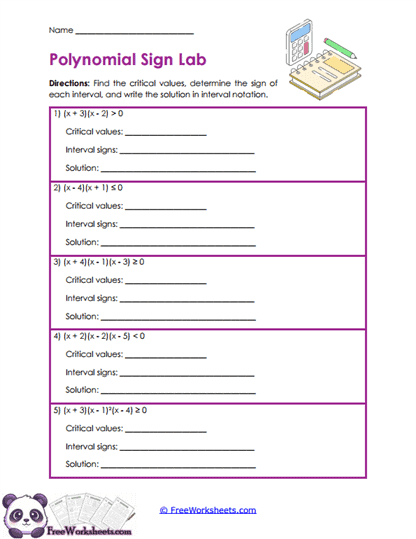
This worksheet helps twelfth-grade Pre-Calculus students practice the complete sign-analysis process for polynomial inequalities. Students work through five factored inequalities. For each one, they find the critical values, determine the sign of the expression on each interval, and then write the final solution in interval notation.
This activity brings together several skills from the earlier worksheets. Students must locate the zeros, divide the number line into sections, determine whether the polynomial is positive or negative in each section, and then keep only the intervals that satisfy the original inequality.
What Students Practice
Students practice finding critical values directly from factored polynomial expressions. Each factor creates a possible zero, and those zeros divide the number line into test intervals.
Students then determine the sign of the whole product in each interval. They may test a convenient value or reason from the signs of the individual factors. If the product has the sign requested by the inequality, that interval becomes part of the solution.
The worksheet also gives students practice deciding whether the critical values themselves belong in the final answer.
Why This Skill Matters
Polynomial inequalities require more than simply solving an equation. The zeros tell students where the expression equals zero, but the inequality asks where the expression is positive, negative, or possibly equal to zero.
This sign-analysis method works well for many higher-degree polynomial inequalities. Once students understand the pattern, they can solve more complicated problems without needing to graph every function.
Common Challenges
Students may find the critical values correctly but forget to test the intervals between them. Remind them that the zeros only create the sections-the sign in each section determines the actual solution.
Another common mistake is assuming the sign must alternate at every zero. Repeated factors can change that pattern, so students should pay attention to the power of each factor or test the intervals carefully.
Students may also use the wrong endpoint notation. If equality is allowed, a polynomial zero may be included. If the inequality is strict, the zeros are excluded.
How To Use It
Teachers can use this worksheet after students have separately practiced finding boundaries and analyzing signs. It works well for independent classwork, homework, review, or preparation for rational inequalities.
Parents and homeschool teachers can encourage students to use the same order every time: find the zeros, make the intervals, determine the signs, choose the correct intervals, then check the endpoints.
Grade Alignment
This worksheet is intended for Grade 12 Pre-Calculus students solving polynomial inequalities. It combines factoring, sign analysis, critical values, and interval notation into one complete process.
Students should already understand polynomial factoring and sign charts. After this practice, they are ready to apply the same reasoning to rational inequalities, where denominator restrictions add another layer.