
About This Worksheet
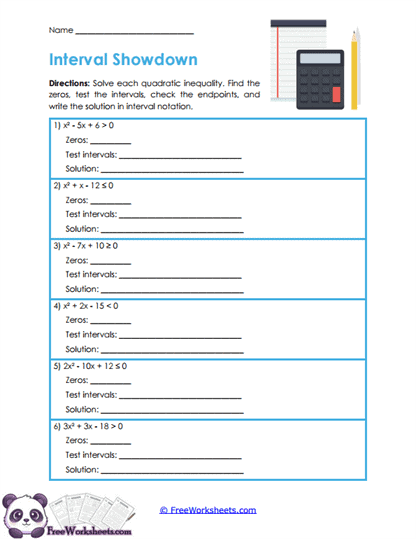
This worksheet helps twelfth-grade Pre-Calculus students practice solving quadratic inequalities by finding zeros, testing intervals, and writing the final answer in interval notation. Students work through six quadratic inequalities and complete the full process from beginning to end.
First, students find the zeros of the related quadratic expression. Those values split the number line into separate intervals. Students then choose a test value from each interval and decide whether the quadratic is positive or negative there. Finally, they keep the intervals that make the original inequality true.
This worksheet gives students a complete look at how quadratic inequalities are solved without relying only on a graph.
What Students Practice
Students practice factoring quadratic expressions and finding the values where the expression equals zero. Those zeros become the dividing points on the number line.
Next, students test one number from each interval. They do not need to test every number because all values inside one interval will have the same sign as long as they do not cross a zero.
Students then write the correct solution using interval notation and decide whether the zeros themselves should be included.
Why This Skill Matters
Quadratic inequalities usually have a range of answers, not just one or two numbers. Interval testing helps students understand exactly which parts of the number line make the inequality true.
This skill also connects algebra to graphing. When a quadratic expression is positive, its parabola is above the x-axis. When it is negative, the graph is below the x-axis.
Understanding both views makes later polynomial and rational inequalities much easier.
Common Challenges
Students may find the zeros and think they are finished. Remind them that the zeros only create the intervals. They still need to find which intervals satisfy the inequality.
Another common mistake is using the wrong endpoint style. If the inequality includes equality, a zero may be included. If the inequality is strict, the zero should be left out.
Students may also test a value incorrectly by making a sign mistake. Encourage them to substitute carefully or use the factored form when possible because it often makes the signs easier to see.
How To Use It
Teachers can use this worksheet after students understand factoring and basic interval notation. It works well for guided examples, independent practice, homework, or quiz review.
Parents and homeschool teachers can remind students of this order: find the zeros, split the number line, test one number in each section, and keep the sections that work.
Grade Alignment
This Grade 12 Pre-Calculus worksheet supports solving quadratic inequalities through factoring, sign testing, and interval notation.
Students should already know how to factor quadratics and solve quadratic equations. After this practice, they can move into more complicated polynomial and rational sign charts.