
About This Worksheet
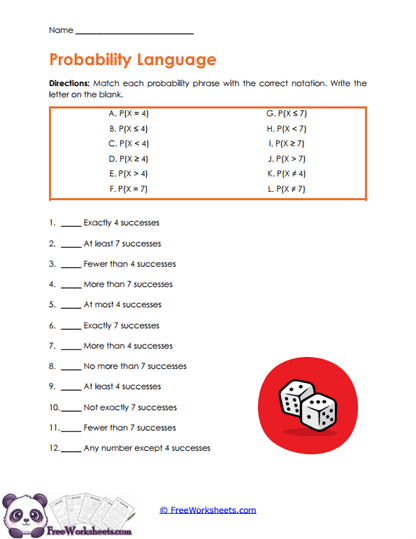
This worksheet helps twelfth-grade Pre-Calculus students practice translating everyday probability phrases into mathematical probability notation. Students match twelve statements such as “exactly four successes,” “at least seven successes,” “fewer than four successes,” and “no more than seven successes” with the correct symbolic form.
The main goal is to help students understand the wording before they calculate anything. Phrases such as “at least,” “at most,” “more than,” and “fewer than” each describe a different group of possible outcomes. Students learn to connect those words with the correct inequality or equality.
What Students Practice
Students practice telling the difference between phrases that sound similar but mean different things. “At least four” includes four and everything larger. “More than four” starts above four and does not include four. “At most seven” includes seven and everything below it, while “fewer than seven” stops before seven.
The worksheet also includes phrases such as “exactly,” “not exactly,” and “any number except.” These help students see that probability notation can describe one specific outcome or a whole range of possible outcomes.
Why This Skill Matters
A large number of probability mistakes happen because students misunderstand the wording before they even begin calculating. If a student reads “at least four” as “more than four,” the wrong outcomes will be included and the final probability will be incorrect.
This skill becomes especially important with cumulative binomial probability. Students need to know whether a boundary value should be included and whether they are finding probabilities below, above, or exactly at a certain number of successes.
Common Challenges
Students often confuse at least with more than. A simple reminder is that “at least four” means four is allowed, while “more than four” means the count must be higher than four.
The same issue appears with at most and fewer than. “At most seven” includes seven, while “fewer than seven” does not.
Another common challenge is deciding whether the probability statement represents one value or several values. “Exactly” points to one outcome, while phrases like “at least” and “no more than” usually describe a range.
How To Use It
Teachers can use this worksheet before students calculate cumulative binomial probabilities. It works well as a warm-up, matching activity, homework assignment, or quick language check.
Parents and homeschool teachers can translate the phrases into plain English first. Ask, “Does this number count too, or do we start above or below it?” That simple question helps students decide whether the boundary should be included.
Grade Alignment
This worksheet is intended for Grade 12 Pre-Calculus students working with probability distributions. It supports accurate interpretation of binomial probability statements and prepares students for exact and cumulative calculations.
Students should already understand basic probability notation and inequalities. After this practice, they are ready to calculate probabilities for exact numbers of successes and ranges of outcomes.