
About This Worksheet
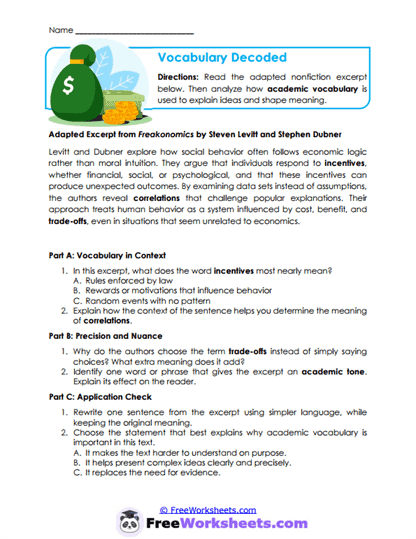
This worksheet helps students understand how academic vocabulary shapes meaning in a nonfiction text. It focuses on analyzing how specific word choices help explain complex ideas. Your child will learn that authors choose words carefully to be precise and clear. For example, a word like “incentives” carries a specific meaning that helps explain behavior, not just a general idea. This helps students become more confident with challenging vocabulary.
Curriculum and Grade Alignment
This worksheet is designed for 12th grade students working on advanced reading and vocabulary skills. The main goal is to determine word meaning in context and understand why certain words are used. Before this, students should know basic vocabulary strategies, and now they are analyzing nuance and precision. The next step is applying academic language in their own writing. It aligns with CCSS.ELA-LITERACY.RI.11-12.4. It also supports TEKS standards related to vocabulary development.
Student Tasks
On this worksheet, students will read a nonfiction excerpt that includes academic language. They will determine the meaning of specific words using context clues. Students will also explain why the author chose certain terms instead of simpler ones. Some questions ask them to rewrite ideas using clearer language while keeping the meaning. This helps them understand both reading and writing skills.
Common Challenges and Misconceptions
Students may try to guess meanings without using context. Some might choose definitions that sound correct but do not fit the passage. Others may not understand why precise vocabulary matters. It is also common to struggle with rewriting ideas clearly. A helpful tip is to ask, “What does this word mean here, and why did the author choose it?”
Implementation Guidance
Teachers can use this worksheet during lessons on vocabulary and informational texts. It works well for helping students handle more complex reading. At home, parents can help by asking their child to explain unfamiliar words in simple terms. This builds understanding and confidence. Practicing with real examples can make learning more meaningful.
Details and Features
This worksheet includes a nonfiction passage and several vocabulary-focused questions. It is designed to build both comprehension and language skills. The format is simple and easy to use. It supports independent work and discussion. The content is relevant and academically appropriate.