
About This Worksheet
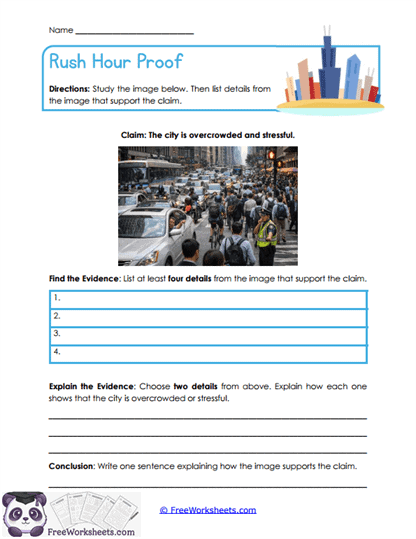
This Grade 7 reading activity teaches students how to use visual evidence to support a written claim. The photograph shows a crowded city street filled with pedestrians, vehicles, and heavy traffic. Students examine small details and decide how each one supports the claim that the city feels overcrowded and stressful. For example, packed sidewalks and cars squeezed closely together both suggest limited space and constant pressure.
Learning Goals
The main goal is to help students understand that a claim must be supported with specific, observable evidence. Students should already be able to describe the basic subject of a photograph. This worksheet moves them toward selecting the most useful details and explaining the connection between each detail and the claim. It supports CCSS.ELA-LITERACY.RI.7.1 and CCSS.ELA-LITERACY.RI.7.7, which focus on citing evidence and interpreting information presented visually.
Student Tasks
On this worksheet, students will study a photograph of a busy city street and list at least four details that support the given claim. They will then choose two of those details and explain how each one makes the city look crowded or stressful. The final response asks them to write one clear sentence showing how the entire image supports the claim. Students must rely on visible details rather than outside knowledge about city life.
Common Challenges
Some students may write broad ideas such as “There are lots of people” without pointing to a more exact part of the image. Others may list evidence correctly but fail to explain why it matters. A detail like traffic becomes stronger evidence when the student connects it to noise, delay, limited movement, or crowding. Ask students to use the frame, “This shows stress because…”
Teaching Suggestions
A teacher can model one example by naming a visible detail and then explaining what it suggests. Students can work in pairs to find several more examples before choosing their strongest evidence. At home, a parent can ask the child to imagine walking through the scene and describe what might make the experience uncomfortable. This helps the student turn visual observations into thoughtful explanations.
Worksheet Features
The worksheet provides one clear claim, one large city photograph, and an organized evidence chart. Separate sections guide students from noticing details to explaining them and finally forming a conclusion. The structure makes the thinking process easy to follow for developing readers. This page works well for argument practice, visual literacy, test preparation, or a quick formative assessment.