
About This Worksheet
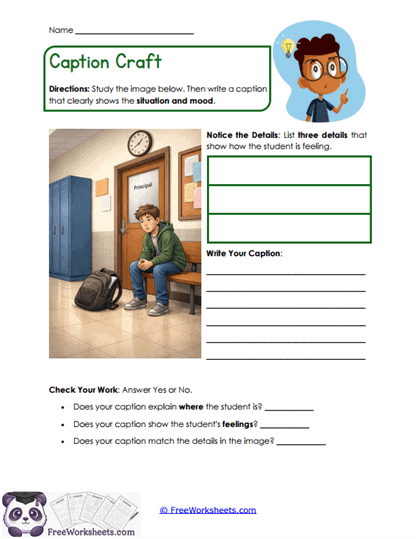
This Grade 7 reading worksheet helps students write a caption that matches both the situation and mood shown in a photograph. The image shows a student sitting outside the principal’s office with a backpack on the floor and a worried expression. Students study small visual details before turning those observations into one clear sentence. For example, the clock, the closed office door, and the student’s posture can help create a caption about nervous waiting.
Learning Goals
The main goal is to help students understand that an effective caption does more than name what is happening. It should also communicate the feeling or meaning suggested by the image. Students should already be able to identify visible details and basic emotions. This activity moves them toward combining evidence, word choice, and tone in a short piece of writing, supporting CCSS.ELA-LITERACY.RI.7.7 and CCSS.ELA-LITERACY.W.7.3.
Student Tasks
On this worksheet, students will examine the picture and list three details that reveal how the student may be feeling. They will then write a caption that clearly explains the situation and captures the mood. Afterward, students use a brief checklist to decide whether the caption tells where the student is, shows the emotion, and matches the visual evidence. Their final sentence should be specific enough to add meaning without becoming a full paragraph.
Common Challenges
Some students may write a label such as “A boy at school” instead of a true caption. Others may guess at a dramatic story that the image does not support. Remind them to stay close to what can actually be seen while still using thoughtful emotion words. A helpful question is, “What detail in the picture makes you believe that?”
Teaching Suggestions
A teacher can show the difference between a weak caption and a stronger one by comparing “Student in hallway” with “A worried student waits outside the principal’s office.” Partners can then underline the words that communicate place and mood. At home, a parent can ask the child to explain the picture aloud before writing. This gives the student a chance to organize the idea before turning it into a concise caption.
Worksheet Features
The page includes a large school-based illustration, a three-detail observation box, and several lines for drafting the caption. A short self-check encourages students to review the content and accuracy of their work. The familiar setting makes the visual clues easy to discuss without giving away one required answer. This worksheet works well for visual literacy, concise writing, tone practice, or a quick classroom warm-up.