
About This Worksheet
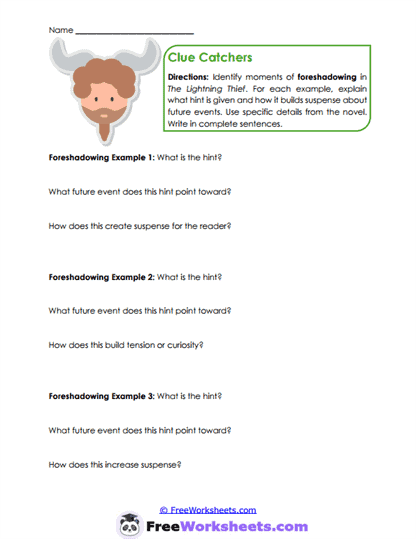
This Grade 7 reading worksheet helps students identify foreshadowing in The Lightning Thief by Rick Riordan. Foreshadowing happens when an author places hints in the story that point toward events that will happen later. Students study three different clues and explain how each one builds curiosity, tension, or suspense. For example, a strange warning may seem small at first but later connect to a major danger Percy must face.
Learning Goals
The main goal is to help students recognize how authors prepare readers for future plot events. Students should already be able to recall important moments and explain what happens later in the novel. This activity moves them toward connecting early details with later outcomes and describing why the author planted those hints. It supports CCSS.ELA-LITERACY.RL.7.5, which asks students to analyze how parts of a story contribute to its overall structure and meaning.
Student Tasks
On this worksheet, students will locate three examples of foreshadowing from The Lightning Thief. For each example, they will identify the original hint and explain what later event it points toward. Students must also describe how the clue creates suspense, tension, or curiosity for the reader. Their answers should include specific details from the novel rather than general memories of the plot.
Common Challenges
Some students may choose an obvious prediction made by a character instead of a subtle clue placed by the author. Others may identify a hint correctly but struggle to explain how it affects the reader. Remind them that foreshadowing often makes readers wonder what will happen without giving the answer away. A helpful prompt is, “When I first read this clue, what question or worry did it create?”
Teaching Suggestions
A teacher can begin by reviewing one familiar example from a movie or story where an early detail becomes important later. Students can then search the novel for warnings, unusual objects, dreams, or comments that gain meaning as the plot unfolds. At home, a parent can ask the child what they would have predicted after reading each clue for the first time. This helps separate foreshadowing from information that only becomes clear after the event has already happened.
Worksheet Features
The page provides matching spaces for three separate examples of foreshadowing. Each section asks students to identify the hint, connect it to a later event, and explain its effect on the reader. This repeated structure gives them several chances to practice the skill without changing the directions each time. The worksheet is useful for plot analysis, close reading, novel review, or preparation for a literary response.