
About This Worksheet
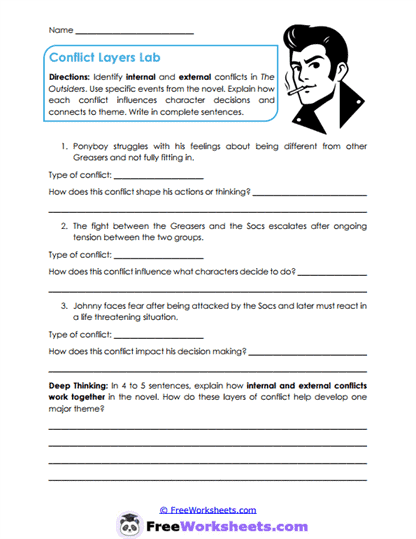
This Grade 7 reading activity helps students separate internal and external conflicts in The Outsiders by S. E. Hinton. Students examine Ponyboy’s private feelings, the rivalry between the Greasers and Socs, and Johnny’s response after a frightening attack. Internal conflict happens inside a character’s mind, while external conflict places the character against another person, group, or situation. For example, Ponyboy’s uncertainty about fitting in is internal, but the fight between rival groups is external.
Learning Goals
The main goal is to show students how different kinds of conflict influence character behavior and move a story forward. Readers should already understand that a conflict is a struggle or problem within a narrative. This worksheet moves them toward explaining how outside pressure can create emotional struggles and how inner fears can shape later decisions. It aligns with CCSS.ELA-LITERACY.RL.7.3, which asks students to analyze how story elements interact and affect characters.
Student Tasks
On this worksheet, students will study three conflicts from The Outsiders and label each one as internal or external. They will explain how Ponyboy’s feelings affect his thinking, how group tension influences choices, and how Johnny’s fear shapes his response to danger. Students must use specific moments from the novel rather than offering general descriptions. The final written response asks them to explain how both kinds of conflict work together in the story.
Common Challenges
Students may assume that every conflict involving another person is only external. A confrontation can also create guilt, fear, anger, or confusion inside the character. Some readers may correctly name the type but fail to explain its effect on a decision. Ask them to connect each conflict to what the character thinks, feels, or does next.
Teaching Suggestions
A teacher can draw two connected circles labeled “outside problem” and “inside reaction.” Students can place events in the first circle and the character’s feelings or choices in the second. Parents can use a familiar example, such as an argument with a friend leading to worry or regret, to make the difference easy to understand. Once students see that the two conflict types often overlap, the final response becomes much stronger.
Worksheet Features
The worksheet presents three recognizable conflicts from different parts of the novel. Each section asks students to identify the conflict and then explain its effect, so the work goes beyond simple labeling. A longer reflection prompt brings the examples together and asks students to examine their relationship. This page is useful for character study, plot analysis, independent review, or preparation for literary writing.