
About This Worksheet
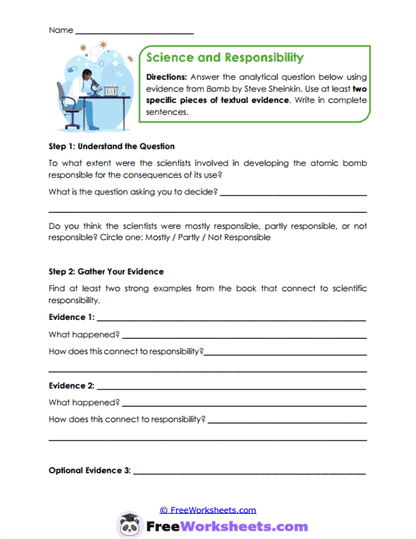
This Grade 7 reading worksheet helps students decide how responsible scientists were for the creation and use of the atomic bomb. Students use Bomb by Steve Sheinkin to study a difficult question that does not have one simple answer. They must look at what scientists knew, what choices they made, and how their work connected to later consequences. For example, helping develop the bomb may show scientific responsibility, while military leaders deciding when to use it may point to responsibility beyond the scientists alone.
Learning Goals
The main goal is to help students form a careful judgment using strong evidence from nonfiction. Readers should already know how to find important details and explain how those details support an idea. This activity moves them toward weighing several pieces of evidence before deciding whether a person or group was mostly, partly, or not responsible. It supports CCSS.ELA-LITERACY.RI.7.1 and CCSS.ELA-LITERACY.RI.7.8, which focus on citing evidence and evaluating ideas, claims, and reasoning.
Student Tasks
On this worksheet, students will first explain what the question is asking them to decide about scientific responsibility. They will choose whether the scientists were mostly responsible, partly responsible, or not responsible for the bomb’s consequences. Students then gather at least two strong examples from Bomb and explain what happened in each one. For every example, they must show how the detail connects to their final judgment.
Common Challenges
Some students may answer based only on their feelings about the atomic bomb instead of using the book. Others may choose a position too quickly without considering how responsibility can be shared among scientists, government leaders, and military officials. Students may also summarize an event without explaining why it matters. Encourage them to finish each piece of evidence with, “This shows responsibility because…”
Teaching Suggestions
A teacher can begin by explaining that responsibility is not always all or nothing. The class might discuss a simple example in which several people contribute to one final outcome. At home, a parent can ask the child who made the discovery, who gave the orders, and who controlled the final use of the weapon. This helps students see why a balanced answer may be stronger than an extreme one.
Worksheet Features
The worksheet breaks the analysis into understanding the question, choosing a position, and gathering evidence. Separate spaces for multiple examples encourage students to build a case instead of relying on one detail. The optional third piece of evidence gives stronger readers room to deepen their response. This page works well for nonfiction study, history integration, ethical discussion, or essay preparation.