
About This Worksheet
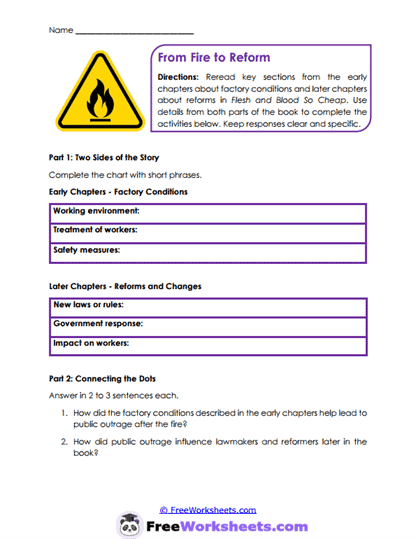
This Grade 7 reading activity helps students compare early factory conditions with later reforms in Flesh and Blood So Cheap. Students organize details about the workplace before the Triangle Shirtwaist Factory fire and then examine the laws, public response, and worker protections that followed. The worksheet shows how authors connect earlier problems with later change across a nonfiction book. For example, locked exits and weak safety rules in the early chapters become reasons for stronger laws and inspections later.
Learning Goals
The main goal is to help students trace how one major event leads to social and political change over time. Readers should already be able to identify cause-and-effect relationships in individual paragraphs. This activity moves them toward connecting information from different sections of a full book. It supports CCSS.ELA-LITERACY.RI.7.3 and CCSS.ELA-LITERACY.RI.7.5, which focus on interactions among events and how ideas develop through text structure.
Student Tasks
On this worksheet, students will reread selected chapters about factory conditions before and after the fire. They will complete a chart describing the working environment, treatment of employees, safety measures, new laws, government action, and the effect on workers. Students then explain how poor conditions led to public outrage and reform. They will also describe how lawmakers and reformers are presented in the later chapters.
Common Challenges
Some students may copy isolated details without showing how the early and later chapters connect. Others may confuse immediate effects of the fire with long-term reforms. Remind them to think in a before-and-after pattern and ask what changed because of the tragedy. A teacher can encourage students to use phrases such as “This problem led to…” and “As a result…”
Teaching Suggestions
A teacher can draw a line down the center of the board and label one side “Before the Fire” and the other “After the Fire.” Students can place evidence on each side and then draw arrows showing the connections. At home, a parent can ask which earlier condition made each later reform necessary. This helps students understand reform as a response to real problems rather than as a random list of laws.
Worksheet Features
The worksheet includes two clearly separated charts for factory conditions and later reforms. Short-answer questions then require students to explain the relationship between those sections. The structure supports both information gathering and deeper analysis. This page works well for nonfiction study, history integration, cause-and-effect review, or essay preparation.