
About This Worksheet
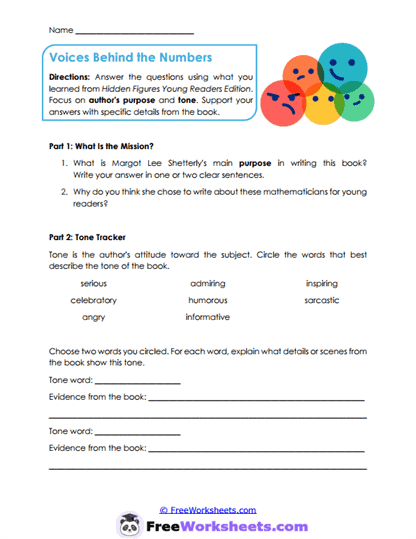
This Grade 7 reading activity helps students study why an author wrote a nonfiction book and how the author feels about the subject. Students use Hidden Figures Young Readers Edition by Margot Lee Shetterly to examine purpose and tone. The worksheet asks them to think about why the author chose to share the stories of Black women mathematicians with younger readers. For example, an admiring tone may appear when the author highlights their intelligence, courage, and important work at NASA.
Learning Goals
The main goal is to help students connect an author’s purpose with the tone created throughout a book. Students should already know that purpose explains why a writer creates a text, while tone shows the writer’s attitude toward the topic. This worksheet helps readers support both ideas with scenes and details instead of making unsupported guesses. It aligns with CCSS.ELA-LITERACY.RI.7.6, which asks students to determine an author’s purpose or point of view and explain how it is developed.
Student Tasks
On this worksheet, students will explain Margot Lee Shetterly’s main purpose for writing the book. They will also consider why she chose to create a version meant especially for young readers. In the tone section, students circle two words that best describe the author’s attitude toward the women in the book. For each tone word, they must provide a detail or scene that shows why the choice fits.
Common Challenges
Students sometimes confuse the author’s purpose with the book’s topic. Saying the book is “about mathematicians” names the subject, but it does not explain why the author wanted readers to learn about them. Tone can also be tricky because several answer choices may seem possible at first. Encourage students to choose words that fit the book as a whole and then prove each choice with clear evidence.
Teaching Suggestions
A teacher can model the difference between topic and purpose using a simple example from everyday life. A book may be about space travel, but its purpose could be to inform readers, honor scientists, or inspire young people. Parents can help by asking how the author seems to feel about the women and what parts of the book create that feeling. This makes tone feel less like a difficult vocabulary word and more like noticing the writer’s attitude.
Worksheet Features
The first section includes two open-ended questions about mission, audience, and purpose. A tone bank gives students several possible attitudes, including serious, admiring, inspiring, humorous, and informative. The follow-up lines require evidence for two separate choices, which prevents students from guessing without support. This worksheet fits biography study, author’s craft lessons, Black history instruction, or independent reading work.