
About This Worksheet
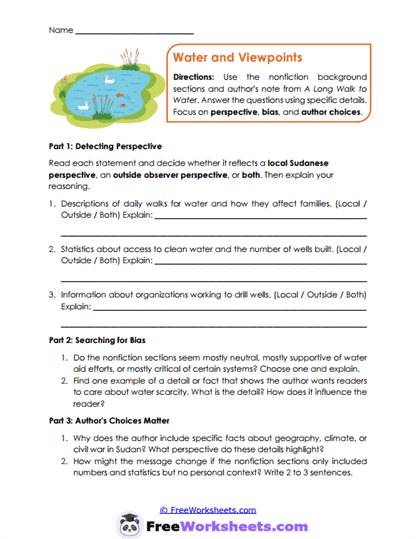
This Grade 7 reading worksheet helps students examine perspective, bias, and author choices in A Long Walk to Water. Students decide whether information reflects a local Sudanese viewpoint, an outside observer’s viewpoint, or both. They also consider whether the nonfiction parts of the book seem neutral or lean toward supporting water-aid efforts. For example, a description of walking long distances for water may show a local experience, while details about aid groups can bring in an outside perspective.
Learning Goals
The main goal is to help students understand that perspective affects which details an author includes and how readers see an issue. Students should already be able to recognize who is speaking and identify important facts in a passage. This activity moves them toward noticing how geography, culture, experience, and purpose shape a nonfiction account. It supports CCSS.ELA-LITERACY.RI.7.6, which focuses on point of view and purpose, along with CCSS.ELA-LITERACY.RI.7.9, which asks students to compare different perspectives on the same topic.
Student Tasks
On this worksheet, students will classify three types of information as local, outside, or shared perspectives. They will explain their choices using details about water access, wells, and organizations working in Sudan. Students then examine whether the nonfiction sections are neutral or supportive of water-aid efforts and defend their answer. The final questions ask them to find an example of outside bias and explain how the author’s selected facts shape the reader’s understanding.
Common Challenges
Students may think perspective and bias mean the same thing. Perspective simply shows where a person is looking from, while bias means the presentation leans toward a certain belief or side. Some readers may also assume that factual writing cannot contain author choices. Remind them that even true facts can create a certain message depending on which facts are included, repeated, or left out.
Teaching Suggestions
A teacher can draw three columns labeled local, outside, and both before students begin. As the class discusses each statement, students can explain why it belongs in one area and not another. At home, a parent can ask whose daily experience is being described and whose knowledge comes from observing or helping. This simple question often makes perspective much easier to recognize.
Worksheet Features
The worksheet is organized into three parts that move from identifying perspective to examining bias and author choices. Students work with concrete examples involving water collection, clean-water statistics, and well-building organizations. Longer response questions encourage them to explain how selected details influence the reader. The page works well for nonfiction book study, global issues, point-of-view instruction, or discussion-based reading lessons.