
About This Worksheet
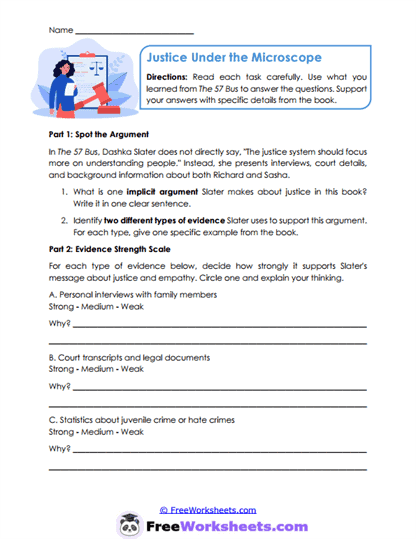
This Grade 7 reading worksheet helps students uncover an argument that an author suggests without stating it in one simple sentence. Students use The 57 Bus by Dashka Slater to decide what the book communicates about justice, people, and the legal system. They also look at several kinds of evidence, including interviews, court records, and crime statistics. For example, details about Richard and Sasha can help students understand that the author wants readers to look beyond a crime and learn about the people involved.
Learning Goals
The main goal is for students to identify an implied argument and explain how the author builds it across a nonfiction book. Readers should already be able to recognize a clear claim and find evidence in a text. This activity takes that skill further by asking them to figure out a message that develops through many chapters and sources. It supports CCSS.ELA-LITERACY.RI.7.8, which asks students to trace and evaluate an author’s argument, claims, reasoning, and evidence.
Student Tasks
On this worksheet, students will write the book’s implied argument about justice in one clear sentence. They will then identify two different kinds of evidence Slater uses and give a specific example of each one. In the second section, students rate personal interviews, legal documents, and statistics as strong, medium, or weak support. For every rating, they must explain why that kind of evidence helps or does not help the author’s larger message.
Common Challenges
Some students may write a broad topic, such as “The book is about justice,” instead of stating what the author seems to believe about justice. Others may give an example from the book without naming the type of evidence it represents. Rating evidence can also be difficult because students may think all facts are equally useful. Encourage them to ask, “How directly does this evidence help prove the author’s message?”
Teaching Suggestions
A teacher can begin by discussing the difference between a subject and an argument. The subject may be the justice system, but the argument explains what the author wants readers to understand about that system. At home, a parent can ask the child to explain the book’s message as though they were describing it to someone who has never read it. Talking through the message first often makes the written sentence clearer and more focused.
Worksheet Features
The worksheet is divided into two parts, so students first identify the argument and then judge the evidence supporting it. Three evidence categories give readers practice comparing personal, legal, and statistical information. Plenty of writing space allows students to explain their thinking with details from the book. This page works well for a whole-class novel study, small-group discussion, homework, or a reading assessment.