
About This Worksheet
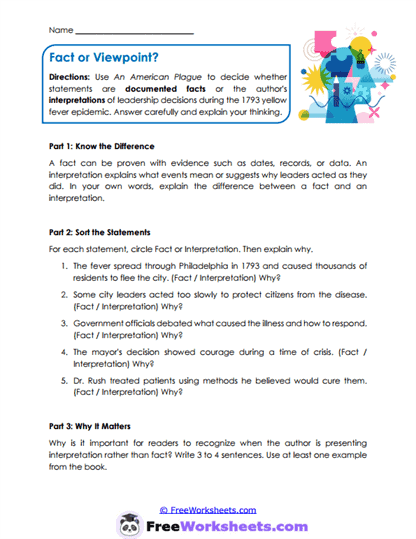
This Grade 7 reading worksheet helps students separate documented facts from interpretations in An American Plague by Jim Murphy. Students examine statements about the 1793 yellow fever epidemic and decide whether each one can be proven directly or reflects someone’s judgment about events. The activity shows that facts are supported by records, dates, or clear evidence, while interpretations explain what those facts may mean. For example, the spread of fever through Philadelphia is a fact, but calling a mayor’s decision courageous is an interpretation.
Learning Goals
The main goal is to help students read historical nonfiction with greater care and notice when an author moves from reporting evidence to explaining it. Students should already be able to locate important details and distinguish basic fact from opinion. This worksheet moves them toward recognizing interpretations that may still be reasonable even though they cannot be proven in the same way as dates or records. It supports CCSS.ELA-LITERACY.RI.7.1 and CCSS.ELA-LITERACY.RI.7.8, which focus on citing evidence and evaluating how ideas and claims are supported.
Student Tasks
On this worksheet, students will review five statements connected to the yellow fever epidemic. They will label each one as a fact or interpretation and explain the reason for their choice. Students must pay attention to words that show judgment, such as “too slowly,” “courage,” or “trusted,” because these terms often signal interpretation. The final response asks them to explain why this distinction matters when reading nonfiction.
Common Challenges
Some students may think every sentence from a nonfiction book must be a fact. Others may label anything emotional as false, even when the interpretation is strongly supported by evidence. Remind them that an interpretation can be thoughtful and fair without being directly provable. A useful question is, “Could this statement be checked in a record, or does it judge what the event means?”
Teaching Suggestions
A teacher can begin with a familiar classroom example, such as “The student arrived at 8:10” and “The student was careless.” The first statement can be checked, while the second depends on someone’s judgment. At home, a parent can ask the child to point out the exact word that turns a factual statement into an interpretation. This keeps the skill concrete and easy to discuss.
Worksheet Features
The page begins with a simple explanation of facts and interpretations before students begin sorting statements. Five examples give repeated practice with both historical evidence and judgment-based language. The final written response asks students to connect the skill to responsible nonfiction reading. This worksheet fits a book study, history lesson, close-reading activity, or independent assessment.