
About This Worksheet
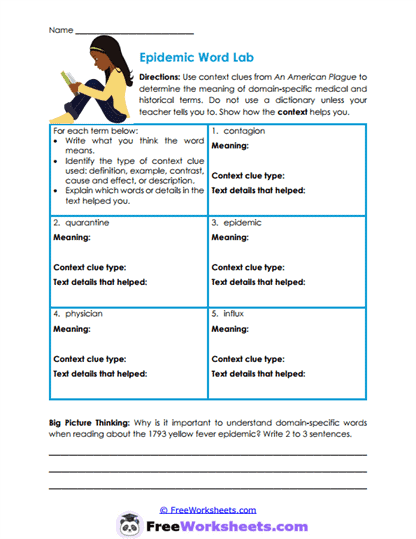
This Grade 7 reading activity teaches students how to use context clues to understand medical and historical vocabulary in An American Plague. The worksheet focuses on words connected to the 1793 yellow fever epidemic, including contagion, quarantine, epidemic, physician, and influx. Students determine each word’s meaning by studying nearby definitions, examples, contrasts, or explanations in the book. For example, a passage describing people being kept apart to stop disease can help students understand the meaning of quarantine.
Learning Goals
The main goal is to help students unlock difficult subject-specific words without depending immediately on a dictionary. Readers should already know that context clues are hints found around an unfamiliar term. This page moves them toward naming the type of clue and explaining exactly which text detail helped them. It supports CCSS.ELA-LITERACY.RI.7.4 and CCSS.ELA-LITERACY.L.7.4, which focus on determining word meaning through context and using knowledge of vocabulary strategies.
Student Tasks
On this worksheet, students will define five domain-specific words from An American Plague. For each term, they will identify whether the author used a definition, example, contrast, cause-and-effect clue, or description. Students must copy or explain the exact part of the text that led them to the meaning. The final response asks them to explain why understanding specialized vocabulary matters when reading about the yellow fever epidemic.
Common Challenges
Students may guess a meaning from what a word sounds like without checking the surrounding passage. Some may identify the correct definition but struggle to name the type of clue used. Others may copy a full sentence without explaining which words were helpful. Encourage them to underline only the smallest useful clue and explain the connection in simple language.
Teaching Suggestions
A teacher can model one term by thinking aloud while reading the sentence around it. The class can then decide whether the author gives a direct definition or expects the reader to infer the meaning from events. Parents can help at home by asking the child to replace the unfamiliar word with an everyday phrase and reread the sentence. If the sentence still makes sense, the meaning is likely accurate.
Worksheet Features
The page uses a five-part chart that gives each vocabulary term its own writing space. Directions remind students to include the meaning, the context-clue type, and the exact supporting detail. The featured words connect directly to medicine, public health, migration, and history. This worksheet fits nonfiction book study, vocabulary instruction, social studies integration, or close-reading practice.