
About This Worksheet
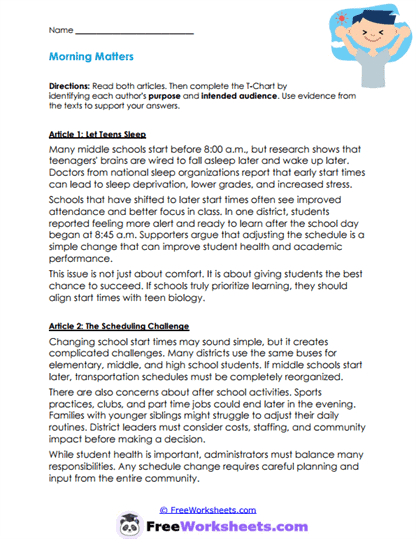
This Grade 7 reading activity helps students compare the purpose and intended audience of two texts about later school start times. The first article emphasizes teenage sleep, health, focus, and academic performance. The second explains the practical scheduling problems that schools may face when changing start times. For example, one author speaks mainly to people concerned about student wellness, while the other addresses readers thinking about buses, staffing, sports, and community planning.
Learning Goals
The lesson’s main goal is to show students that two authors can discuss the same issue for different reasons and for different groups of readers. Students should already understand that an author’s purpose may be to inform, explain, persuade, or warn. This worksheet helps them connect purpose with the details an author chooses to include. It aligns with CCSS.ELA-LITERACY.RI.7.6 and CCSS.ELA-LITERACY.RI.7.9, which focus on purpose, point of view, and comparison across texts.
Student Tasks
On this worksheet, students will read two articles about changing middle school start times. They will complete a T-chart identifying each author’s purpose and likely audience. Students must support their answers with evidence from the passages, such as research about sleep or examples of transportation difficulties. They will also compare how the authors’ different goals shape the information each text emphasizes.
Common Challenges
Students may assume both authors have the same purpose because they write about the same topic. Some may also name a very broad audience, such as “everyone,” without studying the details. Encourage them to ask who would care most about the information and what the author wants that group to understand. Looking at the examples and concerns in each passage can reveal the intended reader.
Teaching Suggestions
A teacher can model the process by reading one paragraph and asking what kind of reader would find those details most useful. The class can then highlight health evidence in one color and scheduling concerns in another. Parents can help by asking whether each text sounds more useful to students, families, teachers, or school leaders. That conversation gives children a practical way to think about audience.
Worksheet Features
The two articles present different sides of the same school policy issue without simply repeating one another. One passage centers on science and student health, while the other focuses on planning and community needs. The T-chart format keeps the comparison organized and easy to follow. This page is useful for lessons on author’s purpose, audience, school issues, and evidence-based responses.