
About This Worksheet
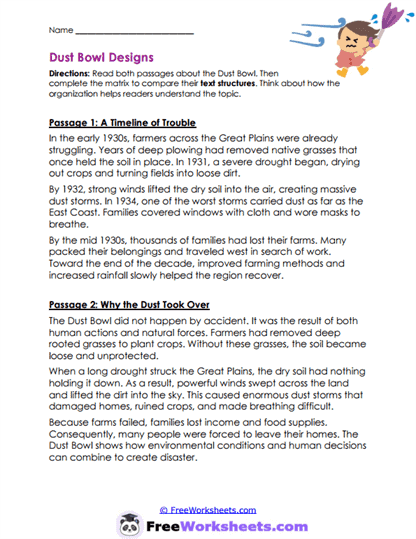
This Grade 7 reading activity helps students compare two text structures used to explain the Dust Bowl. The first passage presents events in time order, showing how drought, dust storms, and migration unfolded across the 1930s. The second uses cause and effect to explain how farming choices, weather, and economic hardship combined to create the disaster. For example, one text tells what happened first and next, while the other explains why the dust storms became so severe.
Learning Goals
The main goal is to help students recognize that authors can organize information in different ways even when writing about the same topic. Students should already know common structures such as sequence and cause and effect. This worksheet moves them toward explaining how structure shapes understanding. It supports CCSS.ELA-LITERACY.RI.7.5 and CCSS.ELA-LITERACY.RI.7.9, which focus on text organization and comparison across sources.
Student Tasks
On this worksheet, students will read two passages about the Dust Bowl. They will compare how one author uses a timeline and the other uses causes and results. Students must complete a matrix showing the structure, key details, and purpose of each text. Their answers should explain how both passages build understanding in different but connected ways.
Common Challenges
Students may confuse a time clue with a cause because the passages contain both. Others may describe the topic of each passage without naming how the information is organized. Remind them that sequence answers “When did it happen?” while cause and effect answers “Why did it happen, and what followed?” Teachers can have students circle time words in one text and underline cause words in the other.
Teaching Suggestions
A teacher can model the difference with a simple classroom example, such as the order of a spilled drink and the reasons it spread. Partners can then identify the strongest structure clues in each Dust Bowl passage. At home, a parent can ask the child to retell one text as a timeline and the other as a chain of causes and effects. This makes the structural contrast easier to hear and remember.
Worksheet Features
The page contains two short historical passages with clearly different organizational patterns. One passage provides dates and chronological movement, while the other explains interacting causes and consequences. A comparison matrix guides students to examine structure instead of only recalling facts. The worksheet fits reading instruction, history integration, and test preparation.