
About This Worksheet
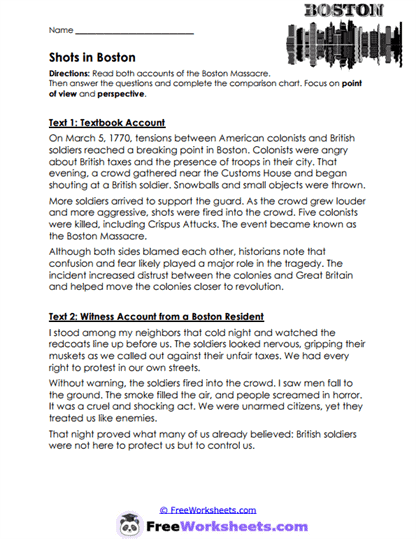
This Grade 7 reading worksheet asks students to compare two very different accounts of the Boston Massacre. The first text gives a textbook-style explanation with dates, events, and historical background. The second presents the emotional voice of a Boston resident who claims to have witnessed the conflict. For example, the textbook account describes rising tension, while the personal account focuses on fear, anger, and the writer’s view of British soldiers.
Learning Goals
The main goal is to help students understand how point of view and perspective shape the way historical events are described. Students should already be able to identify factual details and recognize first-person and third-person narration. This activity moves them toward comparing objective information with a personal, emotional account. It supports CCSS.ELA-LITERACY.RI.7.6 and CCSS.ELA-LITERACY.RI.7.9, which ask students to analyze viewpoint and compare different presentations of the same event.
Student Tasks
On this worksheet, students will read a textbook account and a witness account of the Boston Massacre. They will answer questions and complete a comparison chart focused on point of view and perspective. Students must notice differences in tone, word choice, included details, and emotional language. Their responses should explain how each account changes the reader’s understanding of what happened.
Common Challenges
Some students may assume that the personal account is completely accurate because it sounds direct and confident. Others may believe the textbook version has no perspective simply because it uses a calmer tone. Remind students that every account is shaped by what the author knows, notices, and chooses to include. Ask them to separate what both texts agree happened from the opinions or feelings found in only one account.
Teaching Suggestions
A teacher can begin by asking two students to describe the same classroom event from different seats in the room. This quickly shows how people can notice different details without one person necessarily inventing the story. At home, a parent can ask which account feels more emotional and which provides more background information. Students can then explain why historians often compare several sources before reaching a conclusion.
Worksheet Features
The page places two contrasting historical sources together for direct comparison. One provides broad context, while the other offers a personal voice and strong emotional language. A comparison chart helps students organize differences in perspective rather than simply retell each text. The worksheet fits social studies integration, source analysis, close reading, or a lesson about bias and historical evidence.