
About This Worksheet
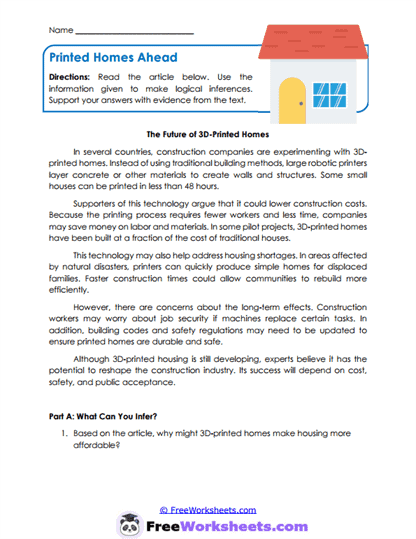
This Grade 7 reading worksheet helps students make logical inferences from an informational article. The passage explains how large printers can build homes with concrete and other materials, while also discussing cost, speed, safety, and long-term concerns. Students must combine details from the text with careful reasoning to reach conclusions that the author does not state word for word. For example, learning that printed homes use fewer workers and less material can lead readers to infer that this method may make housing more affordable.
Learning Goals
The main goal is to help students understand that an inference is a reasonable conclusion supported by evidence from a text. Students should already be able to identify a passage’s central idea and locate important supporting details. This activity moves them toward combining several facts and explaining how those facts lead to a larger conclusion. It supports CCSS.ELA-LITERACY.RI.7.1, which asks seventh graders to cite multiple pieces of evidence when making inferences from informational text.
Student Tasks
On this worksheet, students will read an article about the future of 3D-printed housing. They will answer questions that ask what can reasonably be concluded from information about labor, materials, construction speed, and emergency housing. Students must support each inference with details from the passage instead of relying on guesses or outside knowledge. Their responses should clearly explain how the evidence leads to the conclusion.
Common Challenges
Some students may copy a sentence directly from the article without actually making an inference. Others may offer a possible idea that sounds interesting but is not supported by the passage. Remind students that a strong inference begins with facts from the text and then adds only a small, logical step. A helpful sentence frame is, “The article says ___, so I can infer ___.”
Teaching Suggestions
A teacher can model the first inference by placing the evidence and conclusion in two separate boxes. Students can then explain the thinking that connects the two ideas. At home, a parent might ask the child what could happen if houses were built faster and with fewer workers. This kind of simple questioning helps students practice reasoning without turning the activity into a guessing game.
Worksheet Features
The article uses an interesting technology topic while also addressing practical issues such as housing shortages and natural disasters. Clear directions remind students to use information from the passage and support their answers with evidence. The open-response format gives readers room to explain how they reached each conclusion. This worksheet works well for close reading, science and technology connections, homework, or an inference assessment.