
About This Worksheet
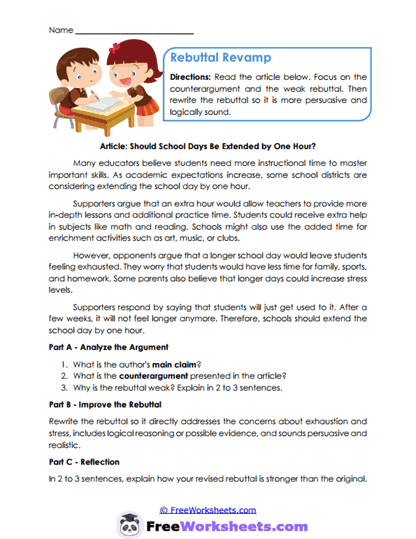
This Grade 7 reading worksheet teaches students how to improve a weak rebuttal in an argument. The article considers whether the school day should be extended by one hour. Students examine a counterargument about tiredness, stress, and reduced family time, followed by a reply that simply says students will get used to it. Their job is to explain why that response is not strong enough and rewrite it with better reasoning.
Learning Goals
The lesson helps students understand that a rebuttal should directly answer the concerns raised by the opposing side. A strong response does more than repeat the author’s opinion or brush the concern aside. It should use reasons, details, or possible solutions that show the writer has taken the other side seriously. This activity supports CCSS.ELA-LITERACY.RI.7.8 and CCSS.ELA-LITERACY.W.7.1, which address evaluating arguments and responding fairly to opposing claims.
Student Tasks
On this worksheet, students will identify the author’s main claim and the counterargument presented in the article. They will explain why the original rebuttal is weak and point out what it fails to address. Next, students rewrite the rebuttal so it responds directly to concerns about exhaustion, stress, and time away from family. The final reflection asks them to explain why their revised answer is more persuasive than the original one.
Common Challenges
Some students may rewrite the rebuttal by simply making it longer without making it stronger. Others may ignore the counterargument and add more reasons supporting a longer school day. Remind them that a rebuttal must answer the exact concern raised by the other side. Suggest that they mention a practical solution, such as breaks, schedule changes, or limits on how the extra hour would be used.
Teaching Suggestions
This worksheet is especially helpful during an argument-writing unit because students can see the difference between dismissing a concern and truly answering it. A teacher might read the weak rebuttal aloud and ask the class what questions are still left unanswered. At home, a parent can pretend to hold the opposing view while the child practices giving a respectful and useful response. That back-and-forth conversation can make rebuttals feel more natural and easier to write.
Worksheet Features
The page is divided into three clear parts that guide students through analysis, revision, and reflection. The article gives enough detail on both sides for students to build a fair response. Specific directions tell them to address fatigue and stress, which keeps the revised rebuttal focused. The activity can be used for reading practice, writing instruction, small-group discussion, or an independent assessment.