
About This Worksheet
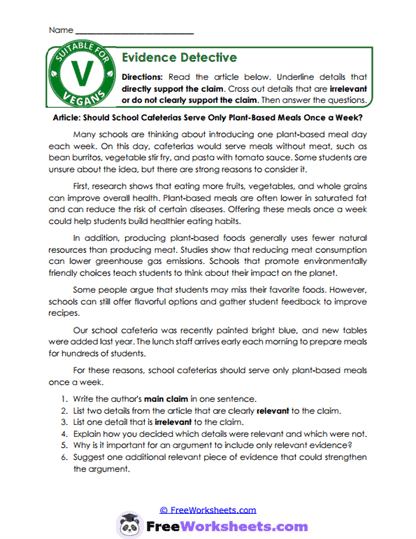
This Grade 7 reading worksheet teaches students how to decide whether evidence truly supports an author’s claim. The article argues that school cafeterias should serve only plant-based meals once each week. Students must separate useful facts from details that may be interesting but do not help prove the main point. For example, information about nutrition and lower resource use supports the claim, while the color of the cafeteria walls does not.
Learning Goals
The main purpose is to show students that relevant evidence must connect directly to the argument being made. Facts do not become strong evidence merely because they appear in the same article. Students practice judging the value of details and explaining why certain information belongs in the argument while other information does not. This activity aligns with CCSS.ELA-LITERACY.RI.7.8, which requires students to trace and evaluate claims, reasons, and evidence in informational texts.
Student Tasks
On this worksheet, students will read an article about offering plant-based meals in school cafeterias. They will write the author’s main claim and locate two details that directly support it. Students must also identify one irrelevant detail and explain why it does not help prove the claim. The final questions ask them to consider why writers include only useful evidence and to suggest another fact that could strengthen the argument.
Common Challenges
A common mistake is choosing a sentence simply because it contains a fact or sounds scientific. Students need to check whether the detail actually helps prove that plant-based meals should be served once a week. They may also struggle to explain why a detail is irrelevant instead of merely labeling it that way. Ask them to finish the sentence, “This detail does not support the claim because…” to guide their reasoning.
Teaching Suggestions
Teachers can model the first decision by drawing a line between the claim and one clearly related piece of evidence. Then they can show that the detail about the cafeteria’s new paint and tables does not connect to health, cost, or environmental benefits. At home, parents can turn the activity into a simple sorting conversation by asking which facts belong in the argument and which ones should be removed. This approach makes the idea of relevance much easier to understand.
Worksheet Features
The passage includes a clear claim, several useful supporting details, an opposing concern, and one purposely unrelated detail. Six questions guide students from identifying the claim to creating stronger evidence of their own. The mix of finding, explaining, and suggesting information gives students more than simple recall practice. Its clean one-page design makes it practical for independent work, guided reading, or an argument-writing lesson.