
About This Worksheet
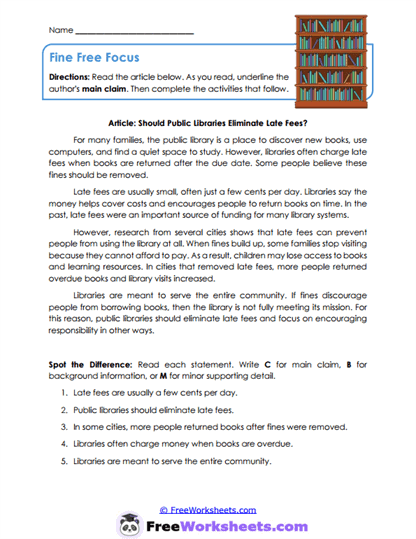
This Grade 7 reading worksheet teaches students how to separate the main claim of an argument from the facts and reasons used to support it. The reading discusses whether public libraries should stop charging late fees for overdue books. Students see how an author can make a clear point and then build support by explaining what happened in cities that removed these fees. For example, the idea that libraries should remove late fees is the claim, while increased book returns after fees were removed is supporting evidence.
Learning Goals
The main goal is to help students understand that every part of an argument has a different job. A claim tells what the author believes, a reason explains why the author believes it, and evidence gives facts or examples that make the reason stronger. Students also practice noticing background information that may be useful but does not directly prove the claim. This work supports Common Core standard CCSS.ELA-LITERACY.RI.7.8, which asks seventh graders to trace and evaluate an author’s argument and specific claims.
Student Tasks
On this worksheet, students will read a short article about public library late fees and underline the author’s main claim. They will then study five statements taken from the passage. Each statement must be labeled as the main claim, background information, or supporting evidence. This makes students slow down and think about how each sentence helps the author make a case.
Common Challenges
Some students may believe that every true statement in an article counts as evidence. Others may choose the topic of the article instead of the author’s actual claim. A helpful question is, “What does the author want the reader to agree with?” Once the claim is clear, students can ask whether each other sentence proves it, explains the situation, or simply adds general information.
Teaching Suggestions
A teacher could use this page after introducing the basic parts of an argument. Read the article aloud once and pause after each paragraph to talk about what that section contributes. At home, a parent can ask the child to explain each label in everyday words before writing an answer. That simple conversation can reveal whether the student truly understands the difference between a claim and a supporting detail.
Worksheet Features
The worksheet uses a short, age-appropriate article built around a real community issue that students can understand. Clear directions explain the three labels students must use, and the five statements provide focused practice without making the page feel crowded. Important terms are printed in bold so students know where to direct their attention. The one-page printable format works well for classwork, homework, tutoring, or a quick reading check.