
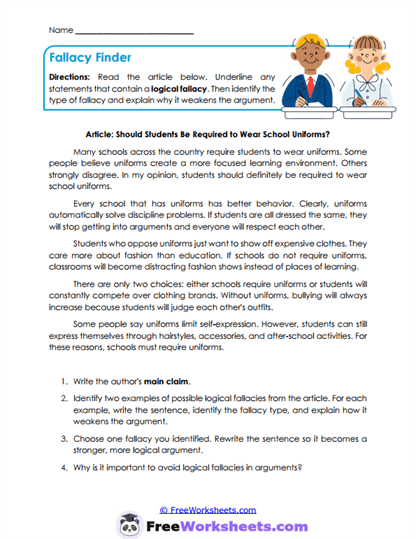
About This Worksheet
This Grade 7 reading worksheet teaches students how to spot weak or misleading reasoning in an argument. The article asks whether students should be required to wear school uniforms. As students read, they look for statements that sound convincing at first but do not hold up when examined closely. For example, saying uniforms will automatically solve every behavior problem is a sweeping claim that the author does not prove.
Learning Goals
The goal is to help students understand that not every reason in an argument is fair, logical, or well supported. Students learn that a logical fallacy is a mistake in reasoning that can make an argument weaker. They also practice naming the type of problem and explaining why it should not persuade the reader. This lesson supports CCSS.ELA-LITERACY.RI.7.8, which asks seventh graders to trace and evaluate an author’s claims, reasons, and evidence.
Student Tasks
On this worksheet, students will read an argument about requiring school uniforms and identify the author’s main claim. They will locate two statements that may contain logical fallacies and name the type of faulty reasoning used in each one. Students must explain how those statements weaken the author’s case instead of simply marking them as wrong. They will then rewrite one weak sentence so it becomes more careful, reasonable, and believable.
Common Challenges
Some students may think that any opinion they disagree with must be a fallacy. Remind them that the problem is not the opinion itself but the way the writer tries to prove it. Students may also notice that a sentence sounds exaggerated without knowing how to explain the flaw. Encourage them to ask, “Is this always true, and did the author give enough proof?”
Teaching Suggestions
This page works well after students have learned a few common fallacies, such as overgeneralization, false cause, and either-or thinking. A teacher might read each questionable sentence aloud and let students explain what makes it unfair or too extreme. At home, a parent can help by changing words such as “always,” “everyone,” and “automatically” into more careful language. That small change often helps children hear the difference between strong reasoning and an exaggerated claim.
Worksheet Features
The passage uses a familiar school topic, so students can focus on the quality of the reasoning instead of learning a difficult subject. Four open-response questions guide them from finding the claim to repairing a weak part of the argument. The final question asks students to think about why fallacies matter, which adds an important reflection piece. Its clear one-page format makes it useful for direct instruction, partner work, or independent practice.