
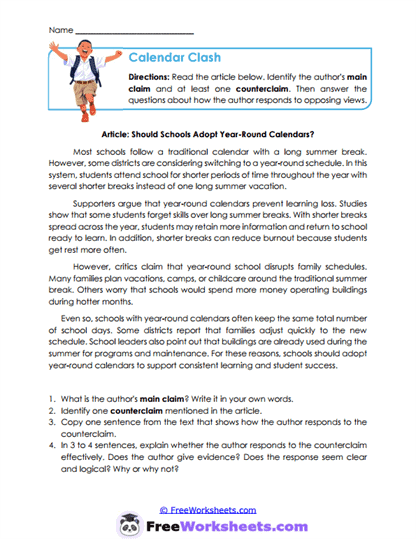
About This Worksheet
This Grade 7 reading activity helps students examine how an author presents an argument and responds to an opposing opinion. The article asks whether schools should use year-round calendars instead of having one long summer break. Students read reasons from both supporters and critics before deciding how well the author answers the counterclaim. For example, concerns about family schedules are answered with the idea that families can adjust when schools provide notice and support.
Learning Goals
The lesson focuses on identifying a main claim, finding a counterclaim, and judging the strength of the author’s response. Students learn that a strong argument should not pretend other opinions do not exist. Instead, the writer should explain the opposing view and answer it with clear reasoning or evidence. This skill connects to CCSS.ELA-LITERACY.RI.7.8 and CCSS.ELA-LITERACY.W.7.1, which cover evaluating arguments and supporting claims while addressing alternate positions.
Student Tasks
On this worksheet, students will read an article about traditional and year-round school calendars. They will restate the author’s main claim in their own words and locate one counterclaim found in the passage. Next, they must copy a sentence showing how the author responds to that opposing point. The final question asks students to judge whether the response is clear, logical, and supported well enough.
Common Challenges
Students sometimes confuse a counterclaim with any sentence that sounds negative. A counterclaim is a real opposing position, not simply a problem mentioned by the author. They may also say that a response is “good” without explaining what makes it effective. Encourage students to look for proof, reasoning, and a direct connection between the concern and the author’s answer.
Teaching Suggestions
This worksheet works nicely for a small-group discussion because students may disagree about whether the rebuttal is convincing. A teacher can place the counterclaim on one side of the board and the author’s response on the other so the connection is easy to see. Parents can support the same thinking by asking, “Did the writer truly answer the concern, or did the writer move on to something else?” Letting the student defend an opinion aloud will make the written response more thoughtful.
Worksheet Features
The article presents both sides of a familiar school issue in language suitable for seventh-grade readers. Four written questions move from basic understanding toward deeper evaluation. Bolded academic words help students focus on the main claim, counterclaim, and quality of the author’s response. The open-ended format gives students room to explain their thinking rather than simply selecting an answer.