
About This Worksheet
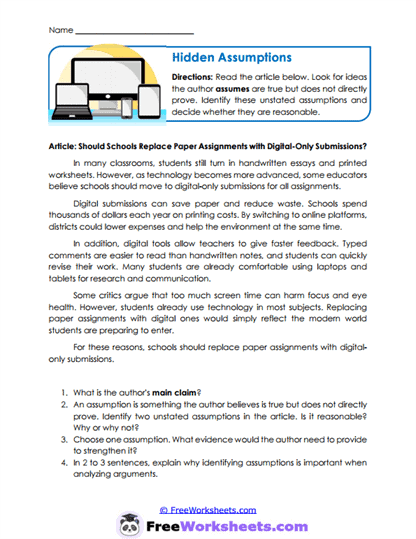
This Grade 7 reading activity helps students uncover ideas that an author takes for granted but does not directly prove. The article argues that schools should replace paper assignments with digital-only submissions. Students look beneath the stated reasons to find beliefs the writer assumes are true, such as every student having reliable access to a working device. For example, “Digital work is easier for everyone” may depend on an unstated belief that all students are comfortable using technology.
Learning Goals
The main goal is to teach students that an assumption is an idea an argument depends on even though the writer may never clearly state it. A hidden assumption can make a claim seem stronger than it really is. Students practice judging whether an assumption is reasonable and deciding what evidence would be needed to support it. This work connects with CCSS.ELA-LITERACY.RI.7.8 because students must examine how sound an author’s reasoning is.
Student Tasks
On this worksheet, students will read an article about replacing paper assignments with digital submissions. They will identify the author’s main claim and locate an unstated assumption that supports it. Students must decide whether that assumption is reasonable and explain why. They will also suggest evidence that could make the claim stronger and reflect on why finding assumptions matters when analyzing an argument.
Common Challenges
Students often confuse an assumption with a fact that is already written in the passage. Explain that an assumption is usually something the author expects the reader to accept without proof. Another challenge is choosing an idea that is related to the topic but not needed for the argument to work. A helpful test is to ask, “Would the author’s claim become weaker if this idea were not true?”
Teaching Suggestions
A teacher can begin by using a simple everyday example, such as, “We should walk to the store because it is close.” The hidden assumptions might be that the weather is safe, the route has sidewalks, and everyone is able to walk. Parents can use the same method at home by asking what must be true for the author’s plan to work well. Talking through one assumption aloud can make the rest of the worksheet feel much less confusing.
Worksheet Features
The article presents clear benefits of digital work while also mentioning concerns about screen time and technology problems. Four written questions help students move from understanding the claim to questioning the ideas underneath it. The worksheet also asks students to supply missing evidence, which strengthens both reading and argument-writing skills. The uncluttered layout leaves enough space for thoughtful answers and works well for classwork or homework.