
About This Worksheet
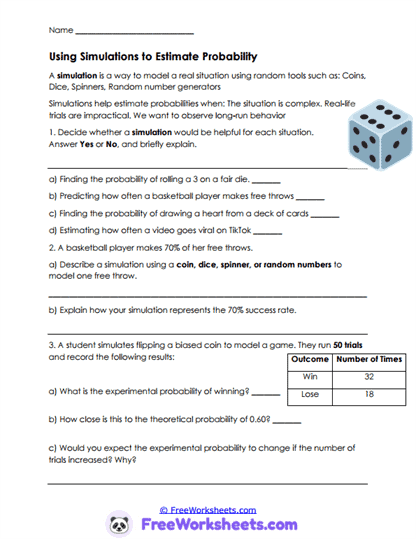
Simulations help students estimate probabilities when real experiments would take too long or be difficult to repeat many times. This worksheet introduces simulations using coins, dice, spinners, and random number methods to model real-world probability situations. Students compare theoretical probability with experimental probability and analyze how repeated trials affect results. For example, students model a basketball player making free throws using a simulation that represents a 70% success rate. The activity helps students understand how probability models predict long-run behavior.
Curriculum and Grade Alignment
This worksheet supports Algebra 2 and high school probability standards involving simulations and experimental probability. The main learning goal is to use simulations to estimate probabilities and compare experimental results to theoretical expectations. Students should already understand theoretical probability and sample spaces before beginning. The next learning step is deeper statistical modeling and data interpretation. This aligns with HSS-CP.A.1 because students model chance processes and interpret probability outcomes.
Student Tasks
On this worksheet, students will determine whether simulations are appropriate for different situations. They will design simulations using coins, dice, spinners, or random numbers and explain how those simulations represent probabilities. Students also calculate experimental probability from trial data and compare it to theoretical probability. Several problems ask learners to predict how results might change with more trials.
Common Challenges and Misconceptions
Some students may confuse theoretical probability with experimental probability. Others may think experimental results must match theoretical values exactly. A common mistake is forgetting that larger numbers of trials usually produce more reliable estimates. Teachers can help by discussing how randomness creates variation in smaller samples.
Implementation Guidance
This worksheet works well after students understand theoretical probability and compound events. Teachers can model a short simulation activity before assigning independent practice. Parents helping at home can use coins or dice to recreate simulations physically and compare outcomes to predictions. Those hands-on experiences often help students understand why simulations are useful.
Details and Features
The worksheet includes simulation design, experimental probability calculations, and probability comparison questions. Students practice modeling chance situations and interpreting trial results. The printable format provides structured spaces for calculations, tables, and written reasoning. The real-world scenarios help students connect simulations to practical probability situations.