
About This Worksheet
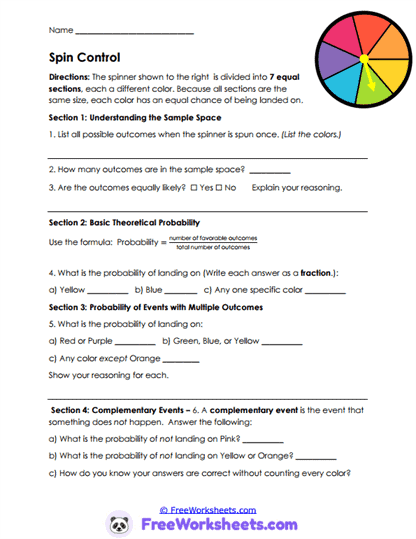
Probability can be modeled using spinners with equal sections to represent equally likely outcomes. This worksheet helps students calculate probabilities from a color spinner and understand how sample spaces connect to theoretical probability. Students identify all possible outcomes, calculate probabilities as fractions, and explore complementary events. For example, the probability of landing on one specific color depends on how many equal sections contain that color. The activity helps students connect visual models to probability reasoning.
Curriculum and Grade Alignment
This worksheet supports Algebra 2 and high school probability standards involving sample spaces and theoretical probability. The main learning goal is to calculate probabilities using equally likely outcomes from a visual model. Students should already understand fractions and basic probability language before beginning. The next learning step is compound probability and probability simulations. This aligns with HSS-CP.A.1 because students describe events and calculate probabilities from sample spaces.
Student Tasks
On this worksheet, students will list all possible spinner outcomes and determine the size of the sample space. They will calculate probabilities for single events, multiple events, and complementary events using fractions. Students also explain whether outcomes are equally likely and justify reasoning using the spinner model. Several problems ask learners to compare probabilities for different color combinations.
Common Challenges and Misconceptions
Some students may forget that all spinner sections are equal in size. Others may count colors incorrectly while determining probabilities. A common mistake is misunderstanding complementary events and forgetting that probabilities must total 1. Teachers can help by encouraging students to count carefully and check whether all outcomes were included.
Implementation Guidance
This worksheet works well during introductory probability lessons involving visual probability models. Teachers can use classroom spinners or digital spinner tools to demonstrate outcomes before assigning independent work. Parents helping at home can create simple homemade spinners to practice similar probability questions. Those hands-on experiences often help students connect probability formulas to real situations.
Details and Features
The worksheet includes sample space practice, single-event probability, compound event probability, and complementary probability problems. Students work with fractions and visual probability models throughout the activity. The printable layout provides organized spaces for calculations and written explanations. The colorful spinner model helps students engage with probability reasoning visually.