
About This Worksheet
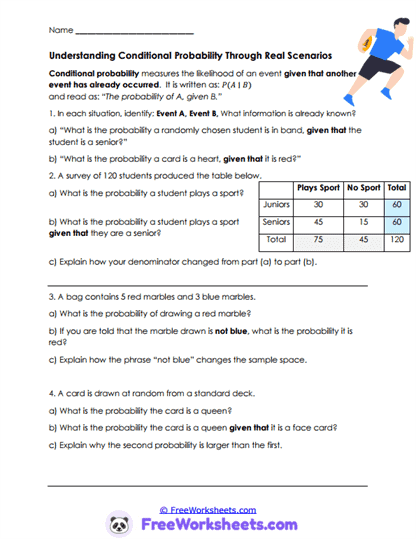
Conditional probability measures the likelihood of an event happening when another event is already known to have occurred. This worksheet helps students understand how known information changes the sample space and affects probability calculations. Students work with tables, marbles, and playing cards to calculate conditional probabilities in context. For example, finding the probability that a student plays a sport given that the student is a senior changes the group being considered. The activity helps students understand how probabilities shift when conditions are added.
Curriculum and Grade Alignment
This worksheet supports Algebra 2 and high school probability standards involving conditional probability. The main learning goal is to calculate probabilities given additional information and understand how the sample space changes. Students should already understand compound events and independent versus dependent events before beginning. The next learning step is probability modeling and advanced statistical reasoning. This aligns with HSS-CP.A.3 because students calculate and interpret conditional probabilities.
Student Tasks
On this worksheet, students will calculate probabilities given specific conditions from tables, card situations, and marble problems. They will compare regular probabilities with conditional probabilities and explain how the denominator changes. Students also interpret conditional probability notation and explain probability changes in words. Several problems ask learners to compare unconditional and conditional probabilities side by side.
Common Challenges and Misconceptions
Some students may continue using the original sample space instead of the reduced conditional sample space. Others may confuse the event being given with the event being measured. A common mistake is forgetting that conditional probability focuses only on a smaller group of outcomes. Teachers can help by encouraging students to underline the condition before solving.
Implementation Guidance
This worksheet works well after students understand independent and dependent events. Teachers can model one conditional probability example using a table before assigning independent work. Parents helping at home can ask students what group is being focused on after the condition is given. Those conversations often help students understand how the sample space changes.
Details and Features
The worksheet includes conditional probability notation, two-way tables, card problems, and marble probability situations. Students calculate probabilities and explain how conditions affect outcomes. The printable format provides organized spaces for fractions, calculations, and written explanations. The structured progression helps students build confidence with conditional probability reasoning.