
About This Worksheet
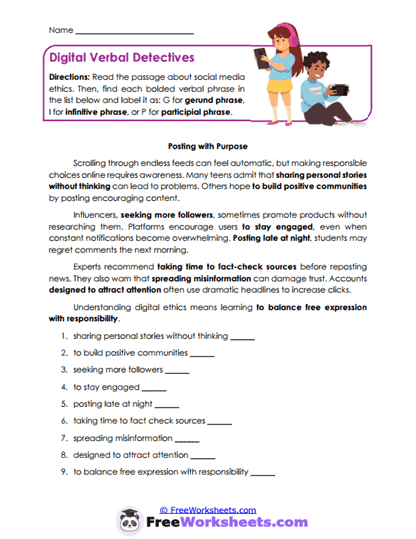
Understanding phrases is a key step toward mastering sentence structure. This worksheet gives students an opportunity to identify and classify several common phrase types while working within a modern, relevant passage about social media, online communication, and digital responsibility.
Rather than studying phrases in isolation, students locate examples directly within an authentic passage. They identify gerund phrases, infinitive phrases, and participial phrases, helping them see how these structures function naturally inside real writing. This approach moves grammar instruction beyond memorization and toward meaningful application.
As students work through the passage, they begin to notice how phrases add depth, detail, and variety to writing. They see that phrases can act like nouns, adjectives, or adverbs, helping writers communicate ideas more effectively. This deeper understanding supports stronger reading comprehension as well as more sophisticated writing.
For parents, this worksheet provides a helpful reminder that grammar is closely connected to communication. When students recognize how phrases work, they become better readers because they can unpack complex sentences more easily. They also become better writers because they gain more options for expressing their ideas clearly and effectively.
Curriculum and Grade Alignment
This Grade 10 grammar worksheet focuses on gerund phrases, infinitive phrases, participial phrases, phrase identification, and sentence analysis. It aligns with CCSS L.9-10.1 and L.9-10.3.
Student Tasks
Students read a passage, locate highlighted phrases, classify phrase types, and analyze how phrases function within sentences.
Common Challenges and Misconceptions
Students sometimes classify phrases based only on the first word they see. Encourage them to examine how the entire phrase functions within the sentence before deciding.
Implementation Guidance
Teachers can use this worksheet as practice during phrase instruction or as a review before more advanced sentence analysis activities. Parents can help students identify whether a phrase acts like a noun, adjective, or adverb.
Details and Features
Students practice phrase identification, grammar analysis, close reading, sentence structure, and language awareness.