
About This Worksheet
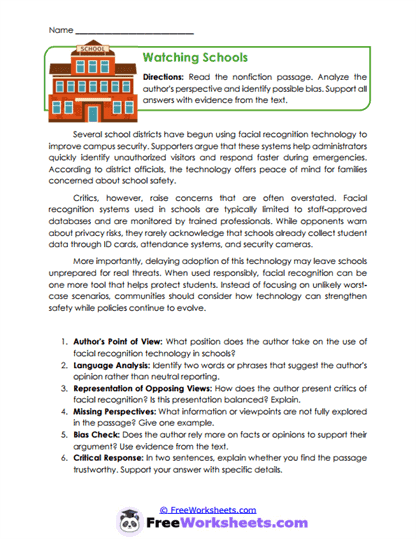
This worksheet is about analyzing an author’s point of view and identifying bias in a nonfiction text. It focuses on reading comprehension and critical thinking for grade 10 students. Students learn how authors present opinions and support them with reasons. For example, a statement like “this is helpful” becomes a supported opinion with evidence and reasoning. This helps students understand how perspective shapes writing.
Curriculum and Grade Alignment
This activity is designed for grade 10 students studying informational text analysis. The main goal is to help students evaluate an author’s stance and recognize bias. Students should already know how to identify main ideas and supporting details. The next step is analyzing how opinions are presented and supported. It aligns with CCSS.ELA-LITERACY.RI.9-10.6 and TEKS §110.32(b)(9), focusing on author’s purpose and perspective.
Student Tasks
On this worksheet, students will read a passage about facial recognition in schools. They will identify the author’s point of view and find words that reveal bias. Students also examine how opposing views are presented in the text. Some questions ask them to evaluate whether the argument is balanced. All responses must include evidence from the passage.
Common Challenges and Misconceptions
Students may confuse facts with opinions when reading the passage. Some might think bias always means something negative instead of recognizing it as perspective. Others may struggle to find specific words that show the author’s stance. It can also be difficult to evaluate whether both sides are presented fairly. Teachers can help by modeling how to highlight opinion-based language in a text.
Implementation Guidance
Teachers can use this worksheet during lessons on argument analysis or media literacy. It works well as a discussion starter about real-world issues. Parents can use it to talk about how news and technology are presented in everyday life. This worksheet is also useful for building critical thinking before writing assignments. Encourage students to explain their reasoning out loud.
Details and Features
The worksheet includes a relevant, real-world topic that engages students. It offers a mix of comprehension and analytical questions. The format is clean and easy to print for classroom or home use. It can be used independently or in group discussions. The activity helps students build skills in evaluating arguments and perspectives.