
About This Worksheet
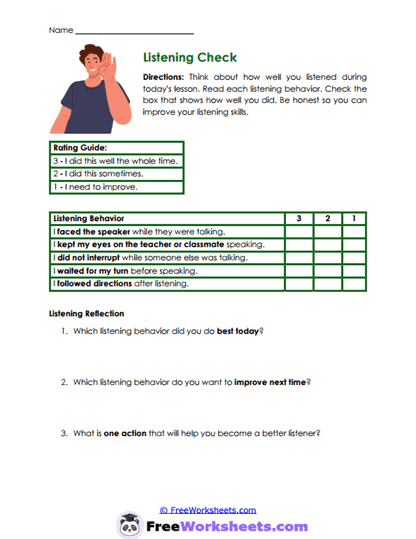
This worksheet is a listening self-check that helps students rate five behaviors that show careful attention during a lesson. It is designed for students in grades 2 through 5 who are learning that good listening includes more than simply being quiet. Children think about whether they faced the speaker, kept their eyes on the speaker, waited their turn, and followed directions. For example, “I listened well” becomes “I faced the speaker and waited until the other person finished talking.”
Curriculum and Grade Alignment
The main goal is to help students understand what active listening looks like in clear and observable terms. Students should already know basic classroom rules for speaking and taking turns. The next skill is using one listening strategy more consistently during future lessons and conversations. This worksheet supports CASEL self-management and relationship skills because students practice attention, patience, respect, and responsible communication.
Student Tasks
On this worksheet, students will rate five listening behaviors using a three-point scale. They decide whether they showed each skill the whole time, sometimes, or not often enough. Students then identify the listening behavior they handled best and the one they want to improve. The final question asks them to name one action that could help them become a better listener.
Common Challenges and Misconceptions
Some students may believe they listened well simply because they did not speak. Others may keep their eyes on the speaker while thinking about something else. Children can also rate every behavior the same without considering each skill separately. Teachers can help by modeling one strong and one weak example of active listening before students complete the chart.
Implementation Guidance
Teachers can use this worksheet after a read-aloud, direct lesson, classroom discussion, or peer presentation. It may also work well during counseling groups or social-skills instruction. Parents and homeschool educators can use it after directions, shared reading, or family conversations. Adults should help the child choose one realistic listening action rather than asking them to improve every skill at once.
Details and Features
The worksheet includes a clear three-point rating guide written in simple language. Five visible listening behaviors appear in an organized chart. Three reflection questions move students from rating to goal setting. The single-page format makes it easy to use after many different speaking and listening activities.