
About This Worksheet
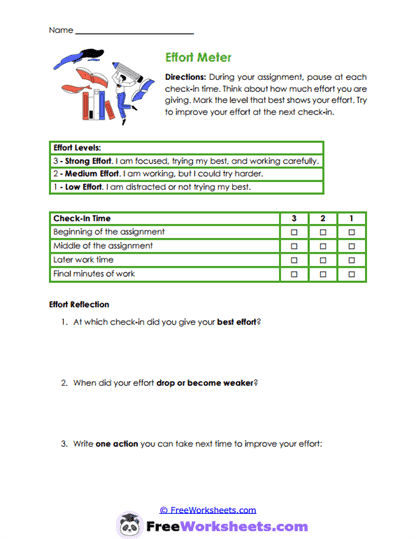
This worksheet is an effort self-check that helps students notice how hard they are working during different parts of an assignment. It is a good fit for students in grades 3 through 6 who are learning that effort can rise or fall as work continues. Children rate themselves at four checkpoints using strong, medium, or low effort. For example, “I worked hard at first” becomes “I showed strong effort at the beginning but needed to refocus during the middle.”
Curriculum and Grade Alignment
The main goal is to help students understand that effort can be monitored and improved before an assignment is over. Students should already know what focused work, careful effort, and distraction look like. The next skill is noticing when effort begins to drop and using a strategy to recover. This worksheet supports CASEL self-awareness and self-management because students evaluate their work habits and make a plan for stronger effort.
Student Tasks
On this worksheet, students will rate their effort at the beginning, middle, later portion, and final minutes of an assignment. They choose a score of one, two, or three at each checkpoint. Students then identify when they gave their best effort and when their effort became weaker. The final question asks them to name one action that may help them work harder next time.
Common Challenges and Misconceptions
Some students may confuse effort with getting every answer correct. Others may give themselves a high score simply because they finished the assignment. Children can also rate low effort as a personal failure instead of seeing it as useful information. Teachers can help by explaining that effort means trying carefully, remaining focused, and returning to work after a distraction.
Implementation Guidance
Teachers can use this worksheet during independent writing, math practice, reading assignments, or longer projects. A timer or quiet signal can remind students when each effort check should happen. Parents and homeschool educators can use the same page during homework or another task that requires steady attention. Adults should help the child compare the checkpoints and choose one strategy for the time when effort usually falls.
Details and Features
The worksheet includes a three-level effort guide with clear descriptions of strong, medium, and low effort. A four-row table tracks effort from the beginning through the final minutes of the assignment. Three reflection questions help students identify their strongest point, weakest point, and next action. The repeated check-ins make it easier for children to notice changes before the task is finished.