
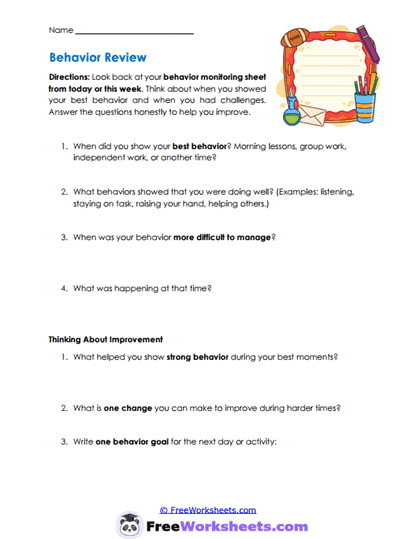
About This Worksheet
This worksheet is a daily behavior review that helps students look back at their strongest choices and their most difficult moments. It is designed for students in grades 3 through 6 who are learning to use information from an earlier monitoring sheet. Children think about when their behavior went well, which skills they showed, and when self-control became harder. For example, “Group work was difficult” becomes “I interrupted classmates during group work when I became excited.”
Curriculum and Grade Alignment
The main goal is to help students turn behavior-monitoring information into a useful reflection. Students should already understand common expectations such as listening, staying on task, raising a hand, and helping others. The next skill is identifying one change that may improve behavior during a similar situation. This worksheet supports CASEL self-awareness, self-management, and responsible decision-making because students examine patterns and choose a clear goal.
Student Tasks
On this worksheet, students will review a behavior-monitoring sheet from the same day or week. They identify when they showed their best behavior and name the skills they demonstrated during that time. Students also explain when their behavior was harder to manage and describe what was happening around them. The final section asks what supported their strongest choices, what change may help during difficult moments, and which behavior goal they will practice next.
Common Challenges and Misconceptions
Some students may answer with broad phrases such as “I was good” or “I had a bad time.” Others may focus entirely on another person’s actions instead of describing their own behavior. Children can also select a goal that has little connection to the challenge they described. Teachers can help by asking students to name one exact action, one setting, and one practical change.
Implementation Guidance
Teachers can use this worksheet after students complete a checklist, rating scale, or daily behavior chart. It works well during an individual conference, dismissal routine, counseling session, or weekly review. Parents and homeschool educators can use it after home lessons, chores, sibling activities, or difficult routines. Adults should begin with the successful moment and help the child carry one helpful strategy into the more challenging setting.
Details and Features
The worksheet includes four questions about strong and difficult behavior moments. A separate improvement section asks students to identify supports, possible changes, and a future goal. Example behaviors are included to help children understand what kind of response is expected. The open-response format gives students room to explain patterns in their own words.