
About This Worksheet
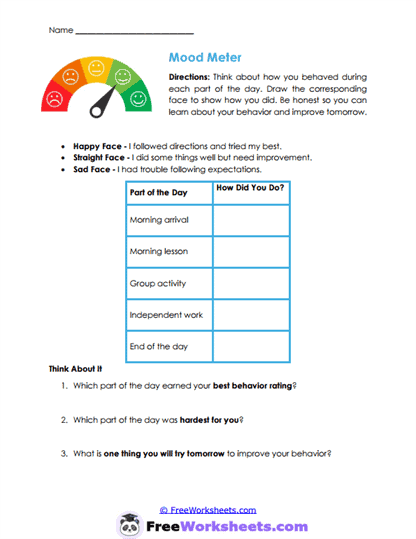
This worksheet is a visual behavior-rating chart that helps students review how well they followed expectations during five parts of the day. It works well for students in grades 1 through 4 who understand facial expressions more easily than number-based scales. Children draw a happy, straight, or sad face to represent their behavior during arrival, lessons, group work, independent work, and the end of the day. For example, “Group work was difficult” becomes “I drew a straight face because I followed some directions but needed reminders.”
Curriculum and Grade Alignment
The main goal is to help students connect daily situations with different levels of behavior success. Children should already know the classroom expectations they are being asked to follow and understand what the three faces represent. The next skill is comparing the ratings to identify where the best choices and greatest challenges occurred. This worksheet supports CASEL self-awareness and self-management because students reflect on several parts of the day and choose one behavior to practice tomorrow.
Student Tasks
On this worksheet, students will draw one face beside each listed part of the school day. They use a happy face when they followed directions and tried their best, a straight face when improvement was needed, and a sad face when expectations were difficult to follow. Students then identify the part of the day with their strongest behavior and the part that was hardest. The final question asks them to write one thing they will try tomorrow to improve.
Common Challenges and Misconceptions
Some students may choose a face based on whether they liked the activity rather than how they behaved. Others may believe that drawing a sad face means they are a bad student. Children can also rate the full day from one recent event instead of thinking about each period separately. Teachers can help by explaining that each face describes a behavior during one short time and does not describe the whole child.
Implementation Guidance
Teachers can ask students to complete each rating soon after the listed activity so the details are still fresh. The visual format makes the page useful for younger learners and students who struggle with longer written reflections. Parents and homeschool educators can replace the school periods with home lessons, chores, playtime, or family routines. Adults should begin by discussing the strongest rating and then help the child choose one simple strategy for the hardest period.
Details and Features
The worksheet provides a three-face key with clear explanations for each behavior level. Five common parts of the school day appear in a large and easy-to-read chart. Three reflection questions help students identify their best period, hardest period, and next improvement step. The open rating boxes allow children to draw faces rather than write long responses.