
About This Worksheet
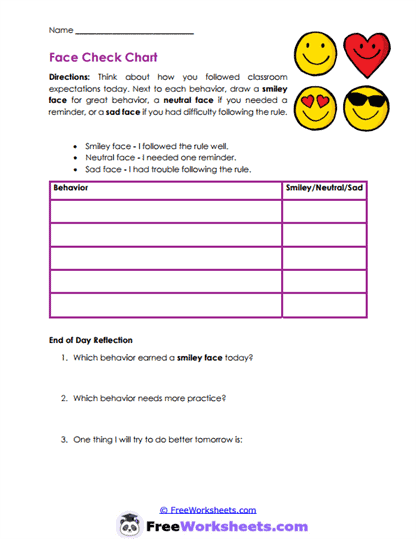
This worksheet is a smiley-face behavior chart that helps students rate several classroom behaviors in a simple and visual way. It works well for students in kindergarten through grade 3 who may find number scales or long written responses difficult. Children choose a smiley, neutral, or sad face for each behavior based on how well they followed the expectation. For example, “I needed help with listening” becomes “I marked a neutral face because I needed one reminder.”
Curriculum and Grade Alignment
The main goal is to help young students connect familiar facial symbols with different levels of behavior success. Children should already know the classroom rules they are rating and understand the meaning of each face. The next skill is identifying which behavior deserves praise and which one needs more practice. This worksheet supports CASEL self-awareness and self-management because students review their choices and prepare for a better response tomorrow.
Student Tasks
On this worksheet, students will write or review several classroom behaviors in the chart. Next to each behavior, they draw a smiley, neutral, or sad face to show how well they followed the expectation. Students then name one behavior that earned a smiley face and one that still needs practice. The last question asks them to write one thing they will try to do better tomorrow.
Common Challenges and Misconceptions
Some students may choose faces based on whether they liked the activity instead of how they behaved. Others may believe a sad face means they are a bad student. Children can also use only smiley faces because they want to make the adult happy. Teachers can help by explaining that the faces describe one behavior at one time and do not describe the whole child.
Implementation Guidance
Teachers can use this worksheet at dismissal, after a morning block, or during a short individual check-in. It may be completed with adult support until students understand how to connect the symbols with real examples. Parents and homeschool educators can use it for daily routines, lessons, or behavior during family activities. Adults should ask the child to explain one face choice so the reflection stays honest and useful.
Details and Features
The worksheet includes a simple key for smiley, neutral, and sad-face ratings. A large open chart allows several classroom behaviors to be added and rated. Three end-of-day questions help students identify success, practice needs, and one next step. The visual format makes the page friendly for early elementary learners.