
About This Worksheet
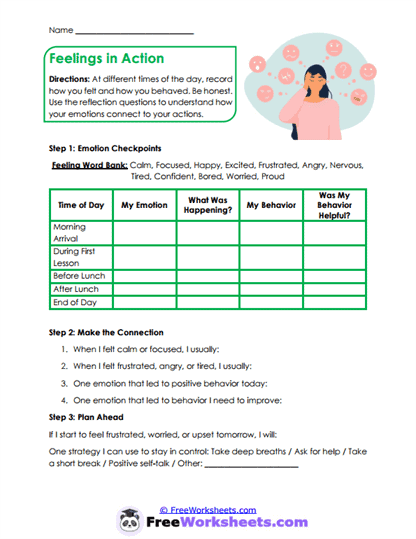
This worksheet is a daily emotion-and-behavior tracker that helps students understand how feelings can influence their actions. It is a good fit for students in grades 4 through 8 who are learning to notice emotional changes across different parts of the day. Children record the emotion, situation, behavior, and result during five daily checkpoints. For example, “I was frustrated after lunch” becomes “I felt frustrated, spoke sharply, and noticed that my response made the situation harder.”
Curriculum and Grade Alignment
The main goal is to help students recognize connections between emotions, events, and behavior choices. Students should already be able to name common feelings such as calm, worried, frustrated, angry, proud, or excited. The next skill is using these patterns to choose a coping strategy before a strong emotion leads to an unhelpful response. This worksheet supports CASEL self-awareness, self-management, and responsible decision-making because students study how emotions affect behavior and create a plan for future situations.
Student Tasks
On this worksheet, students will complete five emotion checkpoints during the school day. They record what they felt, what was happening, how they behaved, and whether the behavior helped the situation. Students then identify what they usually do when calm or focused and what they often do when frustrated, angry, or tired. The final section asks them to name one helpful emotion, one emotion that needs better control, and one strategy they can use tomorrow.
Common Challenges and Misconceptions
Some students may write the same feeling at every checkpoint without thinking about how their emotions changed. Others may confuse the event with the emotion or the emotion with the behavior. Children can also believe that a difficult feeling automatically excuses an unhelpful action. Teachers can help by reviewing one example that clearly separates what happened, what the student felt, and what the student did.
Implementation Guidance
Teachers can use this worksheet during social-emotional learning, counseling, advisory, or individual behavior support. Students may complete each row during the day or fill in the chart during a guided end-of-day review. Parents and homeschool educators can adapt the time periods to lessons, meals, activities, or family routines. Adults should focus on finding patterns and useful strategies rather than judging the feelings the child reports.
Details and Features
The worksheet includes a feeling word bank with a wide range of common emotions. A five-row chart organizes emotions, situations, behavior, and outcomes across the day. Four reflection questions help students connect repeated feelings with repeated actions. The final planning section offers several calming strategies and space for students to add their own.