
About This Worksheet
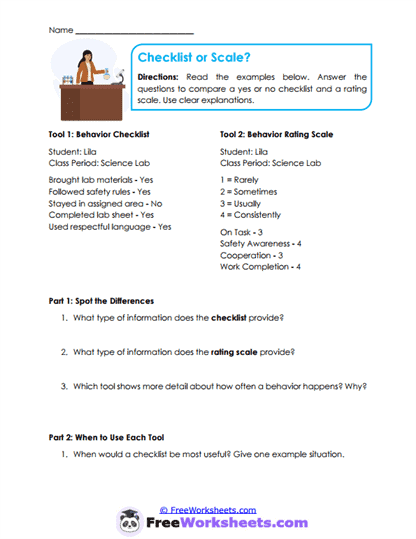
This worksheet is a behavior-monitoring comparison activity that teaches students the difference between a checklist and a rating scale. It is best for students in grades 5 through 8 who are learning how different tools collect different kinds of information. Children compare a yes-or-no checklist with a scale that shows how often or how consistently a behavior occurred. For example, “Lila stayed in her assigned area” becomes a yes-or-no checklist result, while “Lila usually cooperated” becomes a rating-scale result.
Curriculum and Grade Alignment
The main goal is to help students choose a behavior-monitoring tool that matches the type of information needed. Students should already understand that behavior can be observed and recorded in more than one way. The next skill is deciding when a simple completion check is enough and when a range of performance levels gives more useful detail. This worksheet supports CASEL self-management and responsible decision-making because students learn how accurate tools can guide behavior reflection and support.
Student Tasks
On this worksheet, students will compare a completed behavior checklist and a completed behavior rating scale for the same science-lab setting. They explain what kind of information each tool provides and identify which one gives more detail about how often a behavior happens. Students then decide when a checklist would be most useful and provide an example situation. The activity asks them to use clear explanations rather than simply choosing one tool as better in every situation.
Common Challenges and Misconceptions
Some students may believe a rating scale is always better because it includes more numbers. Others may think a checklist measures frequency even though it only shows whether an expectation was met. Children can also overlook that a checklist is useful when adults need quick and simple information. Teachers can help by comparing one behavior recorded both ways and discussing how the purpose of the observation should guide the tool choice.
Implementation Guidance
Teachers can use this worksheet before students begin designing or using their own behavior-monitoring forms. It works well in behavior-support classes, advisory, counseling groups, or lessons about data collection. Parents and homeschool educators can compare simple routine checklists with rating scales used for effort, focus, or cooperation. Adults should emphasize that the best tool is the one that answers the specific question being asked.
Details and Features
The worksheet presents two completed monitoring tools for the same student and class period. The checklist records six expectations with yes-or-no answers, while the rating scale scores four behavior categories from one to five. Comparison questions focus on the type and level of information each tool provides. A second section asks students to apply their understanding by choosing a useful situation for a checklist.