
About This Worksheet
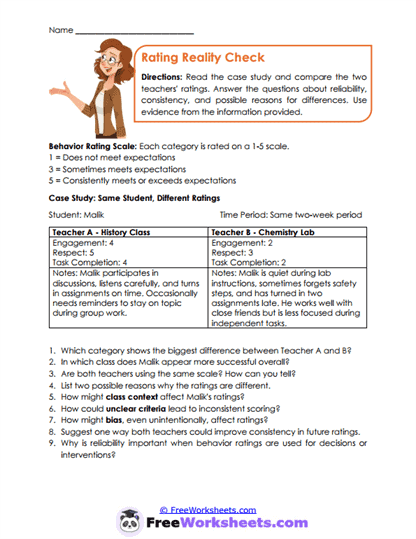
This worksheet is a behavior-rating case study that helps students understand why two teachers may score the same learner differently. It is best for students in grades 6 through 9 who are learning about reliability, context, and fairness in behavior monitoring. Children compare ratings from a history class and a chemistry lab while studying the notes that explain each teacher’s view. For example, “One teacher rated Malik unfairly” becomes “Malik showed different levels of participation and task completion in the two class settings.”
Curriculum and Grade Alignment
The main goal is to help students recognize that behavior ratings can be affected by the setting, task, observer, and type of evidence available. Students should already understand how a one-to-five rating scale works and how written notes can support a score. The next skill is deciding whether rating differences reflect real behavior changes, unclear criteria, or inconsistent observation. This worksheet supports CASEL social awareness and responsible decision-making because students practice looking at several viewpoints before reaching a conclusion.
Student Tasks
On this worksheet, students will compare two teachers’ ratings for Malik’s engagement, respect, and task completion. They identify which category shows the largest difference and decide which class appears more successful overall. Students examine the notes for evidence that may explain the two sets of scores. The remaining questions ask about context, consistency, reliability, possible bias, and ways teachers could improve future ratings.
Common Challenges and Misconceptions
Some students may assume that one teacher must be correct and the other must be wrong. Others may compare only the numbers without reading the classroom notes that give important context. Children can also confuse different behavior across two settings with unreliable scoring. Teachers can help by discussing how class structure, expectations, group work, and independent tasks may all affect what an observer sees.
Implementation Guidance
Teachers can use this worksheet during lessons about behavior data, fairness, observation, or professional judgment. It works especially well for partner discussion because students may notice different pieces of evidence in the case study. Parents and homeschool educators can use the activity to explain why a child may behave differently at home, in class, during sports, or with different adults. Adults should encourage students to consider several possible explanations before deciding that a rating is unfair.
Details and Features
The worksheet includes two side-by-side teacher-rating reports for the same student and time period. Each report provides three numerical ratings along with detailed classroom observations. Nine questions guide students through comparison, context, reliability, bias, and improved scoring practices. The activity builds careful reasoning by requiring learners to use both numbers and written evidence.