
About This Worksheet
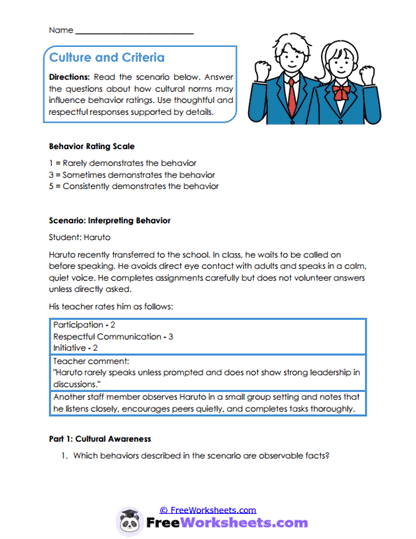
This worksheet is a behavior-rating case study that helps students understand how culture may affect the way actions are interpreted. It is designed for students in grades 6 through 9 who are ready to study fairness, communication differences, and possible bias. Children read about Haruto, whose quiet voice, limited eye contact, and careful participation may be viewed differently by different adults. For example, “Haruto does not show leadership” becomes “Haruto contributes more confidently in a small group than during a whole-class discussion.”
Curriculum and Grade Alignment
The main goal is to help students separate observable behavior from personal or cultural judgments. Students should already understand the difference between facts that can be seen or heard and opinions about what those actions mean. The next skill is using several sources of information before assigning a rating or deciding that a student needs intervention. This worksheet supports CASEL social awareness, relationship skills, and responsible decision-making because students practice considering another person’s background and communication style.
Student Tasks
On this worksheet, students will read a scenario about a student who recently transferred to a new school. They review a behavior scale, teacher ratings, a teacher comment, and an observation from another staff member. Students identify which parts of the scenario are observable facts rather than interpretations. They then use the evidence to think about whether cultural norms may have influenced the original ratings.
Common Challenges and Misconceptions
Some students may assume that every quiet behavior is caused by culture. Others may treat the teacher’s comment as a fact even though parts of it are personal judgments. Children can also believe cultural awareness means lowering expectations for a student. Teachers can help by explaining that expectations can remain clear while the evidence used to judge behavior must still be fair and complete.
Implementation Guidance
Teachers can use this worksheet during lessons about bias, inclusion, classroom communication, or fair behavior assessment. It is especially useful before students examine more complex cases involving different observers or settings. Parents and homeschool educators can use the scenario to discuss how eye contact, speaking style, and participation may look different across families and cultures. Adults should encourage students to ask what else they would need to know before making a firm judgment.
Details and Features
The worksheet includes a three-level behavior rating scale and a detailed student scenario. Numerical ratings are paired with a teacher comment and a second staff observation. The contrast between whole-class and small-group behavior gives students useful evidence to compare. The first written question begins the analysis by asking learners to separate observable facts from interpretations.