
About This Worksheet
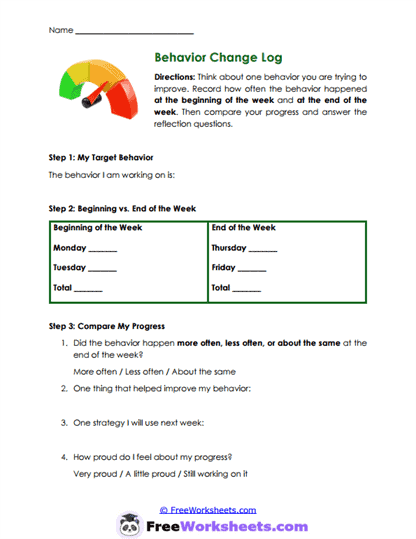
This worksheet is a beginning-and-end behavior comparison that helps students see whether one target behavior changed during the week. It is designed for students in grades 3 through 6 who are ready to count how often a behavior happens and compare two parts of the week. Children record totals for Monday and Tuesday, then compare them with Thursday and Friday to see whether the behavior happened more often, less often, or about the same. For example, “I think I improved” becomes “The behavior happened eight times at the beginning of the week and four times at the end.”
Curriculum and Grade Alignment
The main goal is to help students use simple behavior data to recognize progress. Students should already know how to identify one clear behavior and count how often it occurs. The next skill is using the comparison to decide which strategy should continue during the following week. This worksheet supports CASEL self-awareness, self-management, and responsible decision-making because students review real results and choose a practical next step.
Student Tasks
On this worksheet, students will write the target behavior they are trying to improve. They record the behavior totals for Monday and Tuesday at the beginning of the week and for Thursday and Friday at the end. Students add each pair of daily results to create two larger totals. They then decide how the behavior changed, explain what helped, choose a strategy for next week, and rate how proud they feel about their progress.
Common Challenges and Misconceptions
Some students may choose a behavior that is too broad, such as “being better.” Others may forget that a decrease is only an improvement when the tracked behavior is something they want to reduce. Children can also compare the daily numbers without adding the beginning and end totals correctly. Teachers can help by clearly naming the behavior, stating whether it should increase or decrease, and checking the totals before reflection begins.
Implementation Guidance
Teachers can introduce this worksheet at the start of the week and help the student collect accurate daily numbers. It works well for behaviors such as calling out, staying on task, following directions, or using respectful words. Parents and homeschool educators can use it for homework routines, sibling behavior, emotional reactions, or household responsibilities. Adults should review the results calmly and help the child connect any improvement with a specific choice or support.
Details and Features
The worksheet is divided into three easy steps covering the target behavior, weekly data, and progress comparison. Separate boxes organize the beginning-of-week and end-of-week totals. Four reflection questions guide students through change, helpful supports, future strategies, and feelings about progress. The simple layout makes the page useful for both positive behaviors that should increase and challenging behaviors that should decrease.