
About This Worksheet
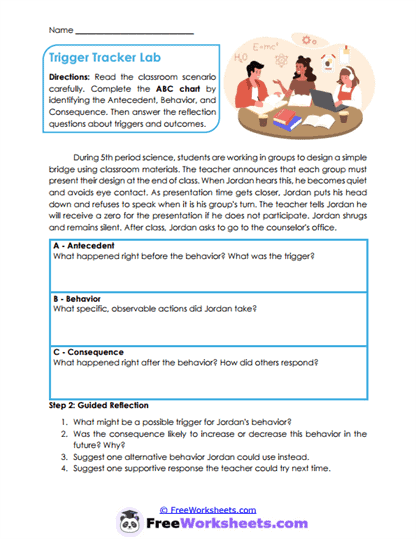
This worksheet is a behavior-scenario activity that teaches students how to identify what happened before, during, and after a behavior. It is designed for students in grades 5 through 8 who are learning to understand why certain reactions happen. Students study a school situation involving frustration, group work, and disrespectful behavior before breaking it into three clear parts. For example, “Jordan became upset for no reason” becomes “A group disagreement happened before Jordan put his head down and refused to speak.”
Curriculum and Grade Alignment
The main learning goal is to introduce the Antecedent-Behavior-Consequence, or ABC, method of behavior analysis. Students should already be able to read a short scenario and identify important actions and events. The next skill is using the same method to examine their own behavior and choose a better response. This worksheet supports CASEL self-awareness, self-management, social awareness, and responsible decision-making because students study triggers, actions, results, and possible alternatives.
Student Tasks
On this worksheet, students will read a classroom scenario about a student named Jordan who becomes upset during a group science activity. They identify the antecedent by explaining what happened immediately before the behavior. Students then describe Jordan’s visible actions and explain what happened afterward, including how other people responded. The guided reflection asks them to suggest a possible trigger, decide whether the consequence may affect future behavior, and offer more supportive choices for Jordan and the teacher.
Common Challenges and Misconceptions
Some students may confuse the trigger with the behavior and place Jordan’s actions in the wrong section. Others may describe feelings or make guesses instead of writing only what could be seen or heard. Children may also assume that a consequence must be a punishment, even though it simply means what happened after the behavior. Teachers can help by reviewing the meaning of each ABC part and using one simple everyday example before students begin.
Implementation Guidance
Teachers can use this worksheet during social-emotional learning, counseling lessons, behavior-support groups, or classroom discussions about problem-solving. It can be completed independently, with a partner, or as a guided whole-class activity. Parents and homeschool educators can use the same ABC method to talk through conflicts, frustration, or difficult learning moments at home. Adults should keep the conversation focused on understanding the situation rather than blaming the student in the scenario.
Details and Features
The worksheet includes a full classroom scenario with enough detail for students to examine the event carefully. Three large response boxes separate the antecedent, behavior, and consequence. Four guided reflection questions move students from identifying facts to suggesting better choices and supportive adult responses. The layout helps learners organize a complicated situation into smaller and easier-to-understand parts.