
About This Worksheet
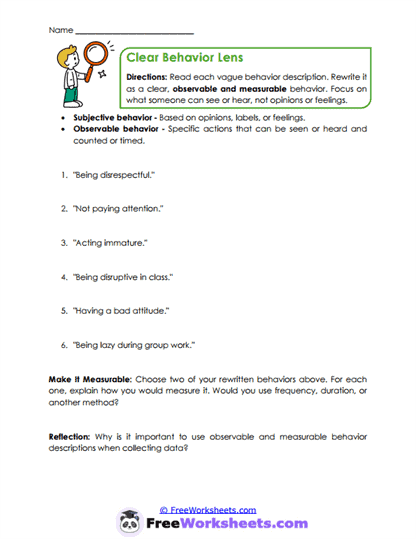
This worksheet is a behavior-description activity that teaches students how to replace vague labels with clear actions that can be seen, heard, counted, or timed. It is best for students in grades 5 through 8 who are learning how accurate language improves behavior tracking. Students rewrite statements such as “being disrespectful” or “not paying attention” so another person would know exactly what happened. For example, “being disruptive” becomes “talking loudly while the teacher is giving directions.”
Curriculum and Grade Alignment
The main goal is to help students understand the difference between subjective opinions and observable behavior. Before using this page, students should be able to identify basic actions in a classroom situation. The next skill is choosing whether a clearly written behavior should be measured by frequency, duration, or another method. This worksheet supports CASEL self-awareness and responsible decision-making because students learn to examine behavior fairly instead of judging a person with negative labels.
Student Tasks
On this worksheet, students will read six unclear behavior descriptions and rewrite each one using specific, measurable language. They focus on actions that another person could actually see or hear. Students then choose two rewritten behaviors and explain how each one could be measured. The final reflection asks why observable descriptions are important when collecting behavior data.
Common Challenges and Misconceptions
Some students may replace one vague label with another, such as changing “lazy” to “unmotivated.” Others may write what they think the student feels instead of describing the action that occurred. Children may also include several behaviors in one sentence, which makes the target difficult to measure. Teachers can help by asking, “What would a camera record?” whenever a response is still unclear.
Implementation Guidance
Teachers can use this worksheet before students begin any formal behavior-tracking activity. It works well during advisory, counseling groups, social-emotional learning lessons, or classroom behavior discussions. Parents and homeschool educators can use the same method to describe home behaviors without using words that may sound blaming or personal. Adults should praise precise language and remind students that clear descriptions make it easier to choose helpful support.
Details and Features
The worksheet gives students six common examples of subjective behavior language to revise. Short definitions explain the difference between subjective and observable behavior before the activity begins. A measurement section asks students to connect their rewritten examples with frequency, duration, or another data method. The final reflection helps learners understand why fair and exact wording matters during behavior monitoring.