
About This Worksheet
This worksheet is a class-participation tracker that helps students notice how actively and respectfully they contribute during lessons. It is best for students in grades 3 through 7 who are learning that participation includes more than speaking often. Children tally meaningful behaviors such as sharing ideas, asking questions, responding respectfully, using evidence, and staying engaged. For example, “I stayed quiet because I had no answer” becomes “I asked a helpful question about what I did not understand.”
Curriculum and Grade Alignment
The main learning goal is to help students understand what thoughtful classroom participation looks like. Students should already know how to listen, take turns, and follow discussion rules. The next step is contributing ideas that are clear, relevant, and supported by examples or evidence. This worksheet supports CASEL relationship skills, self-awareness, and self-management because students review both the quality of their contributions and their ability to stay involved.
Student Tasks
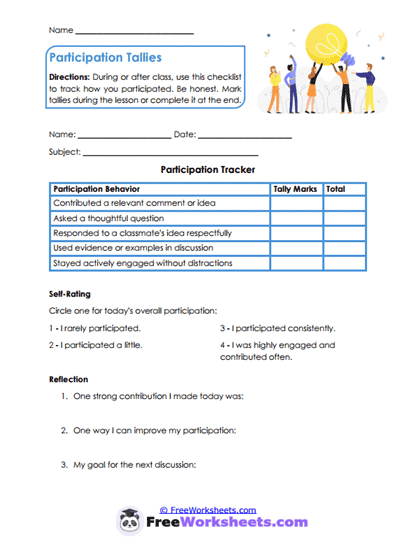
On this worksheet, students will add tally marks when they show one of five participation behaviors during class. They track relevant comments, thoughtful questions, respectful responses, supporting details, and active engagement without distractions. After the lesson, students circle an overall participation rating from one to four. The reflection section asks them to describe one strong contribution, identify one way to improve, and set a goal for the next discussion.
Common Challenges and Misconceptions
Some students may think participation means talking as often as possible. Others may overlook listening and staying engaged because those behaviors are less visible than raising a hand. Quiet students may rate themselves too low even when they contributed through thoughtful questions or respectful responses. Teachers can help by explaining that strong participation is based on quality, attention, and respect rather than the number of times a student speaks.
Implementation Guidance
Teachers can use this worksheet during reading discussions, science lessons, social studies conversations, or group problem-solving activities. Students may record their own tallies, or the teacher can help younger learners track them. Parents and homeschool educators can use it during shared reading, oral lessons, or family learning discussions. Reviewing the final reflection gives adults a chance to praise one meaningful contribution and help the child plan a stronger next step.
Details and Features
The worksheet includes spaces for the student’s name, date, subject, and class information. Five participation behaviors appear in a chart with columns for tally marks and totals. A four-point self-rating scale helps students describe their overall level of involvement. Three reflection prompts encourage children to recognize a success, choose an improvement, and prepare for the next discussion.