
About This Worksheet
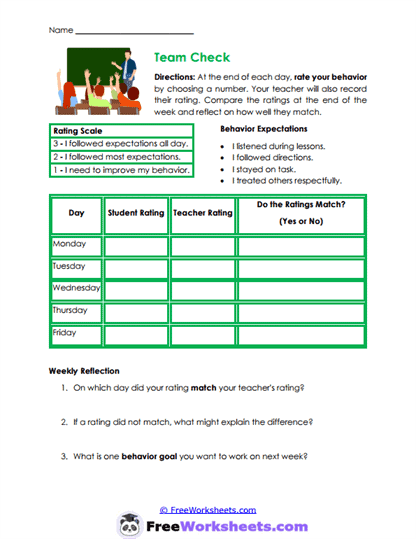
This worksheet is a weekly student-and-teacher behavior comparison that helps children see where two viewpoints match or differ. It is a good fit for students in grades 3 through 6 who are learning to rate themselves honestly and respond calmly to adult feedback. Both the student and teacher choose a score from one to three each day based on listening, following directions, staying focused, and showing respect. For example, “I thought I followed expectations all day” becomes “I gave myself a three, while my teacher gave me a two because I needed reminders.”
Curriculum and Grade Alignment
The main goal is to help students understand that self-ratings and teacher observations can work together to create a fuller picture. Students should already know what the four behavior expectations mean and how the three-point scale works. The next skill is discussing score differences with specific examples and choosing one goal for the following week. This worksheet supports CASEL self-awareness, relationship skills, and responsible decision-making because students practice honest reflection, feedback, and shared planning.
Student Tasks
On this worksheet, students will give themselves one daily behavior rating from Monday through Friday. Their teacher records a separate rating for the same day using the same scale. Students mark whether the two scores match and then compare the results at the end of the week. The reflection questions ask when the ratings agreed, why a difference may have happened, and which behavior goal the student wants to practice next.
Common Challenges and Misconceptions
Some students may treat the ratings like a contest and try to prove that their score is correct. Others may change their rating because they want it to match the teacher’s number. Children can also assume that a difference means someone is being unfair or dishonest. Teachers can help by giving one calm example and explaining that two people may notice different moments during the same day.
Implementation Guidance
Teachers can ask students to complete their rating before seeing the teacher’s score. A short daily conversation can be used when the two ratings differ greatly, while longer discussion can wait until the weekly review. Parents and homeschool educators can use the same process by comparing a child’s self-rating with an adult observation during home learning. Adults should begin with an agreement, discuss one difference respectfully, and end with a shared goal.
Details and Features
The worksheet includes a three-point scale that explains meeting expectations, following most expectations, and needing improvement. A five-day table places student ratings, teacher ratings, and match results side by side. Four behavior expectations appear above the chart as clear reminders. Three reflection questions guide students toward comparison, explanation, and next-week planning.