
About This Worksheet
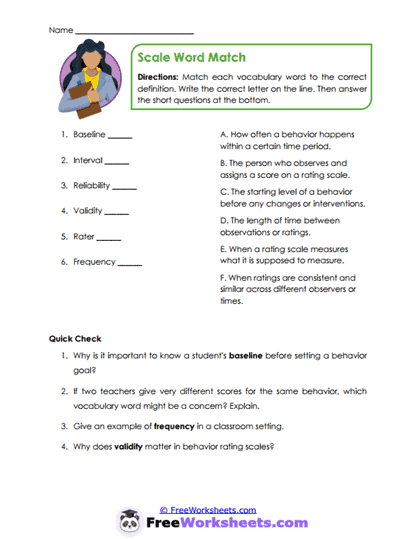
This worksheet is a behavior-measurement vocabulary activity that teaches students the meaning of six important rating terms. It is a good fit for students in grades 6 through 9 who are beginning to study how behavior data is collected and judged. Children match words such as baseline, reliability, validity, rater, frequency, and interval with their correct definitions. For example, “baseline means the behavior goal” becomes “baseline means the starting level before a strategy or intervention begins.”
Curriculum and Grade Alignment
The main goal is to build the vocabulary students need to understand behavior rating scales and progress-monitoring systems. Students should already know that behavior can be observed, counted, timed, and rated. The next skill is using these terms correctly while studying real data or comparing different rating tools. This worksheet supports responsible decision-making because students learn why accurate words and dependable measurements matter when adults make choices about student support.
Student Tasks
On this worksheet, students will match six behavior-data terms with six definitions. They must distinguish between how often a behavior happens, who gives the score, and whether a rating tool measures what it is supposed to measure. The quick-check questions ask why baseline information is useful and which term explains very different scores from two teachers. Students also create a classroom example of frequency and explain why validity matters in a behavior scale.
Common Challenges and Misconceptions
Some students may confuse reliability with validity because both words relate to the quality of a rating tool. Others may mix up frequency and interval since both involve observing behavior during time periods. Children can also assume that the rater is the person receiving the score rather than the person giving it. Teachers can help by connecting each word with one short classroom example before students complete the matching section.
Implementation Guidance
Teachers can use this worksheet before lessons on behavior data, rating scales, interventions, or progress reports. It works well as an individual activity followed by partner discussion of the quick-check answers. Parents and homeschool educators can use the page to introduce the language behind school behavior plans and data charts. Adults should ask students to explain the terms in their own words instead of relying only on the matching letters.
Details and Features
The worksheet includes six key vocabulary words and six clear definitions. A matching format provides a simple way to check basic understanding before students answer deeper questions. Four written responses require students to apply the terms to goals, teacher ratings, classroom behavior, and measurement quality. The activity combines vocabulary practice with real behavior-monitoring concepts on one printable page.