
About This Worksheet
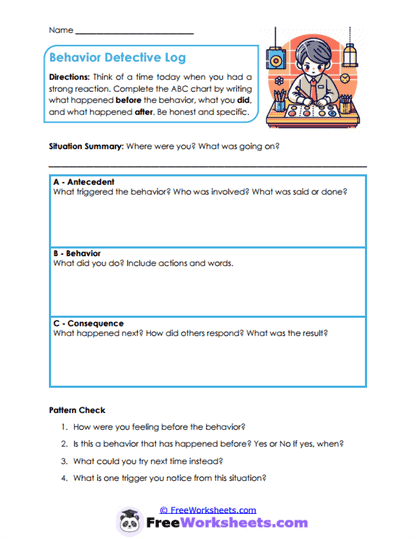
This worksheet is an ABC behavior log that helps students study what happened before, during, and after a strong reaction. It is designed for students in grades 5 through 8 who are ready to think carefully about why certain behaviors may repeat. Children describe the setting, identify the trigger, record their actions and words, and explain what happened next. For example, “I suddenly became angry” becomes “I became angry after a classmate laughed while I was speaking.”
Curriculum and Grade Alignment
The main learning goal is to help students understand the relationship between triggers, behavior, and consequences. Students should already be able to describe a recent situation and tell the difference between an action and a feeling. The next skill is noticing repeated patterns across several situations and choosing a healthier response before the behavior grows stronger. This worksheet supports CASEL self-awareness, self-management, and responsible decision-making because students examine their reactions without avoiding responsibility.
Student Tasks
On this worksheet, students will begin by writing where they were and what was happening during a strong reaction. They complete the antecedent section by identifying what happened immediately before the behavior and who was involved. In the behavior section, students describe exactly what they said and did, followed by the consequence and the way others responded. The final pattern check asks about feelings, repeated situations, better choices, and whether a larger trigger may be involved.
Common Challenges and Misconceptions
Some students may place their feelings in the behavior section instead of describing actions that could be seen or heard. Others may confuse the consequence with a punishment, even though it simply means what happened afterward. Children may also blame another person for the entire situation and leave out their own choices. Teachers can help by using calm, judgment-free questions and reminding students that understanding the pattern is more useful than deciding who was “bad.”
Implementation Guidance
Teachers can use this worksheet after the student has calmed down and is able to think clearly about the event. It may be completed during a counseling meeting, behavior conference, restorative conversation, or quiet reflection period. Parents and homeschool educators can use it after arguments, homework struggles, sibling conflicts, or emotional outbursts at home. Adults should guide the student through the facts first and discuss possible triggers only after the full situation has been described.
Details and Features
The worksheet includes a short situation-summary line followed by three large ABC response boxes. Each section contains guiding questions that help students include the most important details. Four pattern-check questions encourage students to look beyond one event and consider repeated triggers or reactions. The spacious layout gives learners enough room to describe the situation honestly and clearly.