
About This Worksheet
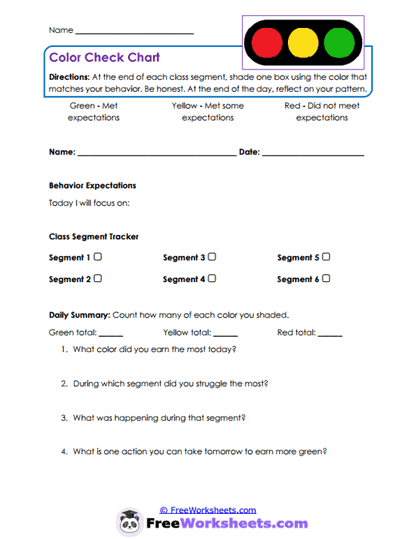
This worksheet is a color-based behavior tracker that helps students quickly rate how well they met expectations during different parts of a lesson or day. It is designed for students in grades 1 through 5 who benefit from a simple visual system. Children shade each segment green, yellow, or red based on how closely their behavior matched the chosen expectation. For example, “I struggled during one lesson” becomes “I marked that segment yellow and thought about what made it harder.”
Curriculum and Grade Alignment
The main goal is to help students notice changes in their behavior across several short time periods. Students should already understand the meaning of the three colors and know the specific expectation they are tracking. The next step is using the color pattern to identify triggers and choose one helpful action for the next day. This worksheet supports CASEL self-awareness and self-management because students pause, rate their choices, and plan how to respond more successfully.
Student Tasks
On this worksheet, students will write the behavior expectation they want to focus on for the day. After each of six class segments, they shade one box green, yellow, or red to show how well they met that expectation. Students then count the number of boxes in each color and record the three totals. The reflection questions ask them to identify the most common color, examine the hardest segment, explain what was happening, and choose one action that may lead to more green ratings.
Common Challenges and Misconceptions
Some students may view a red box as proof that they failed instead of seeing it as useful information. Others may choose colors based on mood rather than the behavior expectation written at the top. Children can also shade every box green because they want to please the adult reviewing the page. Teachers can help by defining each color clearly and showing that honest yellow and red ratings can lead to better support.
Implementation Guidance
Teachers can use this worksheet for daily self-monitoring, behavior check-ins, or classroom routines divided into clear segments. It works especially well for younger students who understand visual signals more easily than number scales. Parents and homeschool educators can use the same color system for lessons, chores, transitions, or homework periods. Adults should review difficult segments with curiosity and help the child choose one specific action rather than giving a general reminder to “do better.”
Details and Features
The worksheet includes a clear traffic-light key explaining green, yellow, and red behavior ratings. Six class-segment boxes give students several chances to review and reset their behavior. A daily summary area organizes the number of ratings in each color. Four reflection questions guide students toward finding patterns, identifying difficult situations, and planning a more successful response.