
About This Worksheet
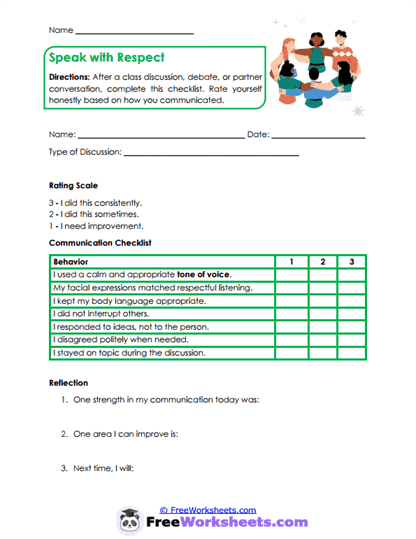
This worksheet is a communication checklist that helps students review how respectfully they spoke and listened during a discussion. It is designed for students in grades 4 through 8 who are learning to share ideas without interrupting, arguing, or using an unkind tone. Students rate several speaking and listening behaviors and then reflect on one strength and one area for growth. For example, “I attacked the person’s idea” becomes “I disagreed politely and explained my own thinking.”
Curriculum and Grade Alignment
The main learning goal is to help students understand that respectful communication includes words, tone, body language, and listening. Students should already know how to take turns and follow the basic rules of a classroom conversation. The next skill is using these habits during debates, partner talks, and discussions where people may disagree. This activity supports CASEL relationship skills and responsible decision-making because students examine how their communication choices affect others.
Student Tasks
On this worksheet, students will rate how consistently they used respectful communication during a class discussion or partner conversation. They review their tone of voice, facial expressions, body language, listening, responses to ideas, and ability to stay on topic. Each behavior receives a score of one, two, or three based on how often it was shown. Students then describe one communication strength, identify an area to improve, and write what they will do differently next time.
Common Challenges and Misconceptions
Some students may think respectful speaking only means avoiding rude words. Others may use polite language while rolling their eyes, interrupting, or speaking in an angry tone. Children can also believe that disagreement itself is disrespectful and may avoid sharing a different opinion. Teachers can help by modeling the difference between disagreeing with an idea and criticizing the person who shared it.
Implementation Guidance
Teachers can use this worksheet after classroom debates, book talks, group discussions, or partner problem-solving activities. It works best when students complete it soon after the conversation and can remember specific moments. Parents and homeschool educators can use it after family discussions, shared reading, or sibling learning activities. Adults should point out one example of respectful communication before helping the student choose a realistic improvement goal.
Details and Features
The worksheet includes a simple three-point rating scale that explains each level of performance. Seven communication behaviors appear in a clear chart with spaces for student ratings. The reflection section encourages students to recognize a strength, name a challenge, and plan a better response. Its printable one-page design makes it easy to use with many different speaking and listening activities.