
About This Worksheet
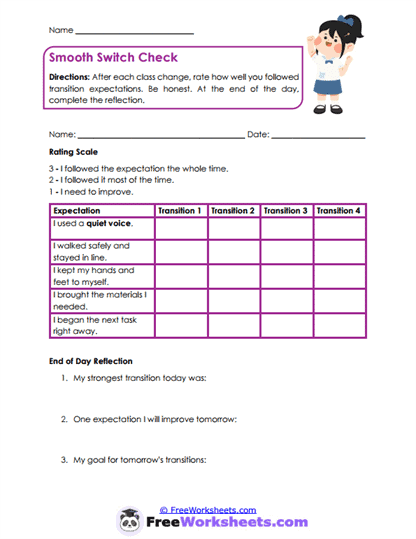
This worksheet is a transition-behavior tracker that helps students review how well they move from one classroom activity to another. It is a good fit for students in grades 2 through 6 who need support with following directions, organizing materials, and beginning new tasks without delay. Students rate five expected behaviors across four separate transitions and then reflect on their strongest and weakest habits. For example, “I wandered after the bell” becomes “I gathered my materials and began the next task right away.”
Curriculum and Grade Alignment
The main learning goal is to help students understand what a calm and successful transition looks like. Children should already know the classroom rules for voice level, movement, personal space, and handling supplies. The next skill is completing these routines independently even when the class is busy or the student feels excited. This worksheet supports CASEL self-management because students practice controlling their bodies, attention, materials, and time during changing situations.
Student Tasks
On this worksheet, students will rate their behavior during four classroom transitions. They review whether they used a quiet voice, walked safely, kept their bodies to themselves, brought the needed materials, and started the next task right away. Each behavior receives a score of one, two, or three based on how consistently the expectation was followed. At the end of the day, students identify their strongest transition, choose one expectation to improve, and write a goal for the following day.
Common Challenges and Misconceptions
Some students may think transitions are free time because one activity has ended and the next has not fully begun. Others may focus only on walking quietly while forgetting to bring materials or begin work promptly. Children who struggle with attention may not remember which transition caused the problem. Teachers can help by reviewing the chart soon after each transition and using the same short reminder before the next one begins.
Implementation Guidance
Teachers can use this worksheet during times such as changing subjects, returning from specials, moving to lunch, or preparing for dismissal. It may be completed after each transition or reviewed once at the end of the school day. Parents and homeschool educators can adapt it for moving between homework, chores, meals, and free time. A brief conversation about one successful transition can help the child see that smooth routines are possible and can be repeated.
Details and Features
The page provides a clear three-point scale that explains consistent behavior, partial success, and areas needing improvement. A large chart allows students to rate five expectations across four transitions. Three reflection prompts encourage students to recognize a strength, select one behavior for improvement, and create a goal. The worksheet’s simple printable layout supports daily use, short-term behavior plans, and progress monitoring.