
About This Worksheet
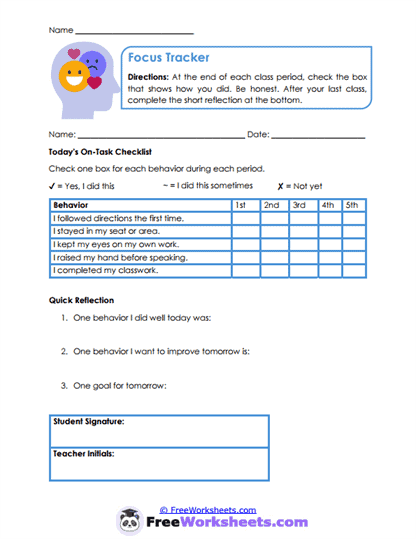
This worksheet is a daily behavior checklist that helps students notice how well they stay focused and follow classroom expectations. It works well for elementary students in grades 2 through 5 who are learning to manage their actions without constant adult reminders. Students check their behavior after each class period and then think about one success and one area that needs more work. For example, “I forgot to raise my hand” becomes “I will pause and raise my hand before I speak.”
Curriculum and Grade Alignment
This activity supports behavior monitoring, self-management, and responsible decision-making. Students should already understand basic classroom rules, such as listening to directions, remaining in their work area, and waiting for a turn to speak. The next step is for students to use what they notice to set a small and realistic behavior goal. The worksheet connects closely with the CASEL self-management competency because children are asked to track their choices and work toward better control of their behavior.
Student Tasks
On this worksheet, students will check one box after each class period to show how often they followed five important classroom behaviors. They review whether they followed directions, stayed in their seat or assigned area, kept their eyes on their work, raised their hand, and completed their classwork. At the bottom, children write about one behavior they handled well and one behavior they would like to improve. They also create a goal for the next school day and complete spaces for a student signature and teacher initials.
Common Challenges and Misconceptions
Some students may check “yes” for every behavior because they believe that is the answer adults want to see. Others may focus only on one difficult moment and decide that the entire class period went badly. Children can also confuse making one mistake with being a poorly behaved student. Teachers can help by reminding students that honest answers are useful and that the checklist measures choices, not personal worth.
Implementation Guidance
A teacher can place this worksheet in a student’s folder and ask the child to complete it quietly at the end of each class period. It can be especially helpful for students who need a clear visual reminder of the behaviors that support learning. Parents can review the completed page at home and begin by talking about something the child did well. The final goal can then become a simple point of encouragement for the following day.
Details and Features
The page includes a five-period tracking table with clear yes, sometimes, and not-yet choices. Five classroom behaviors are written in simple language so students know exactly what they are reviewing. A short reflection area encourages children to move beyond checking boxes and think about their next step. Signature and teacher-initial spaces make it easy to share progress between the student, school, and home.